Rotisserie Herbed Chicken
I love this simple herb butter mixture for roasted chicken and it made an amazing rotisserie chicken.
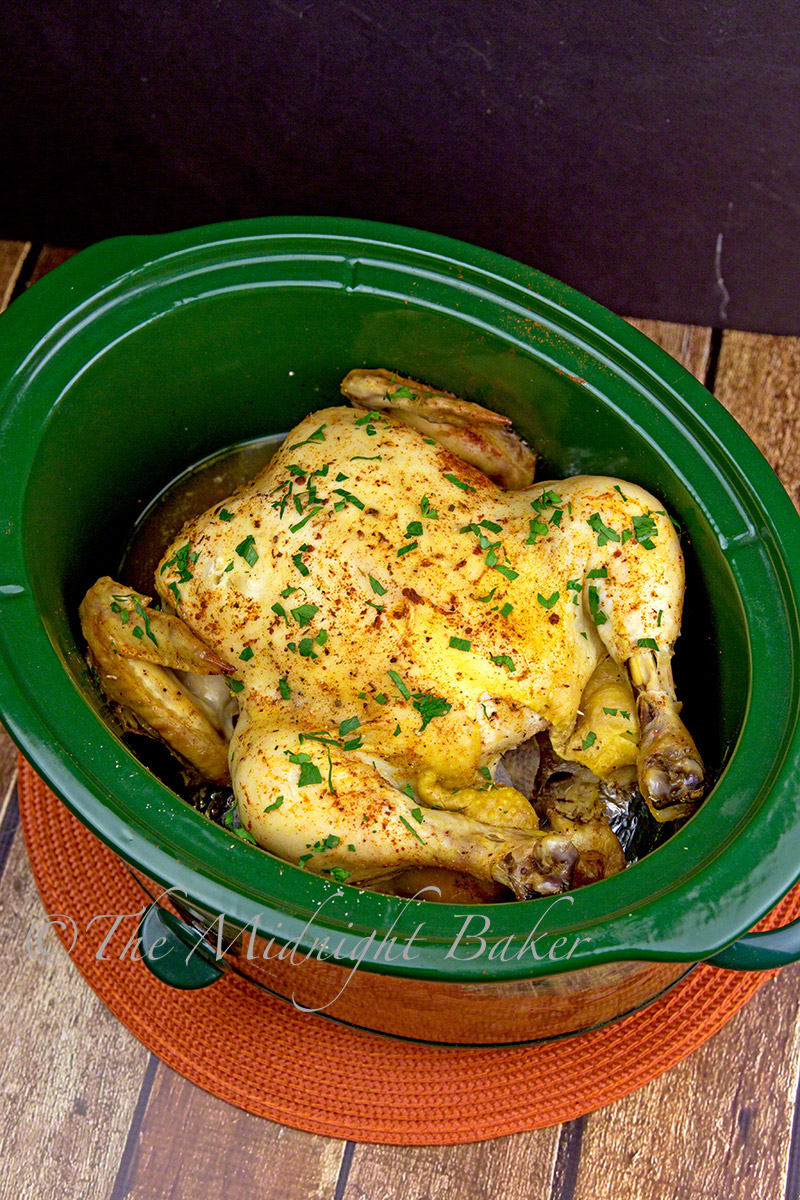
I love this simple herb butter mixture for roasted chicken and it made an amazing rotisserie chicken.
- Carbohydrate 0.285626666644821 g
- Cholesterol 375.503125013081 mg
- Fat 80.8354150049349 g
- Fiber 0.164174995422363 g
- Protein 85.7067408333844 g
- Saturated Fat 27.1381442531253 g
- Serving Size 1 1 (476g)
- Sodium 706.262941701663 mg
- Sugar 0.121451671222458 g
- Trans Fat 6.70302425034548 g
- Calories 1092 calories
Step-by-step
- Combine the herbs, Kosher salt and pepper in a food processor and grind into a fine mince.
- Soften the butter slightly in the microwave or allow to soften on the counter (if you have the patience). We are talking softened here, not melted. We need the butter to stick to the chicken, not immediately drip off the carcass.
- Combine the herbs and butter in a small bowl.
- Rinse the whole chicken with cold water and make sure you remove all of the nasty bits from inside the cavity and then pat the chicken dry with paper towels.
- Carefully separate the skin from the breast meat using your fingers and tuck some of the herbed butter mixture up under the skin of the chicken.
- Rub the remaining herbed butter concoction all over the outside of the chicken.
- Secure the chicken to the rotisserie, following the instructions of your model.
- Use a piece of cooking twine to secure the chicken legs together and to the rotisserie, to keep your chicken from kicking your pan over or losing a limb during rotation.
- Place a pan of water underneath the chicken to catch the drippings and to provide steam during the cooking process.
- Light your burners to medium-high heat (per your rotisserie''s instructions) and cook with the lid closed until a thermometer inserted into the breast meat reads 160 degrees. It will take about an hour and a half for a 4 pound whole chicken.
- Carefully remove the chicken from the rotisserie and either carve or eat it whole with your hands like a Caveman (or Woman)! Don''t forget that yummy skin.
Why does butter slide off warm poultry instead of staying put? Softening fat just enough to create a workable paste without melting it completely is the only way to trap dried herbs against the skin so they do not burn off in the radiant heat. When dried thyme, rosemary, and fennel seeds are pulverized in a food processor alongside kosher salt and black pepper, the abrasive salt crystals break down the botanical cell walls, releasing aromatic essential oils. Mixing these ground spices into softened dairy creates an insulating layer that protects the delicate breast meat underneath from drying out during rotation.
- Grind the fennel seeds thoroughly with the thyme and rosemary; large whole seeds will char quickly over an open flame and turn bitter.
- Ensure the butter reaches a malleable, room-temperature state rather than a liquid state, or the fats will immediately separate and slide off the bird when applied.
- Tie the legs securely with kitchen twine to maintain balance on the spit, preventing uneven rotation that causes lopsided rendering.
- Place a water pan beneath the rotating bird to capture drippings while simultaneously generating steam that moderates dry radiant heat.
- Pull the chicken from the heat source when an instant-read thermometer inserted into the thickest part of the breast reaches 160 degrees Fahrenheit, allowing carryover cooking to finish the process.
- Substitute lard or high-smoke-point vegetable shortening at a one-to-one ratio if dairy is unavailable, though browning reactions will differ slightly due to milk solids.
Thoroughly drying the cavity and exterior skin with paper towels removes surface moisture that would otherwise convert to steam and prevent adequate fat rendering. Securing the bird properly ensures steady thermal transfer throughout the cooking cycle.



