Rosettes
Rosettes are a type of fried pastry that is made from a batter of flour, eggs, milk, and sugar. They are typically shaped into rosettes using a special rosette iron. Rosettes can be served plain or sprinkled with confectioners' sugar.
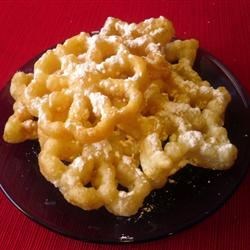
Rosettes are a type of fried pastry that is made from a batter of flour, eggs, milk, and sugar. They are typically shaped into rosettes using a special rosette iron. Rosettes can be served plain or sprinkled with confectioners' sugar.
- Carbohydrate 17.9038107225279 g
- Cholesterol 1.12666666734295 mg
- Fat 1.02190069466424 g
- Fiber 0.201747225782606 g
- Protein 1.29936816688443 g
- Saturated Fat 0.252385500899737 g
- Serving Size 1 1 Serving (36g)
- Sodium 12.0491777804829 mg
- Sugar 17.7020634967453 g
- Trans Fat 0.0653784924291744 g
- Calories 86 calories
Step-by-step
- Combine eggs, sugar and salt; beat well. Add remaining ingredients and beat until smooth.
- Heat a rosette iron in deep, hot oil (375 degrees) for 2 minutes.
- Drain excess oil from iron. Dip in batter to 1/4 inch from the top of the iron, then dip iron immediately into hot oil (375 degrees).
- Fry rosette until golden, about 30 seconds. Lift out; tip upside down to drain. With fork, push rosette off iron onto a rack placed over paper towels.
- Reheat iron 1 minute; make next rosette.
- Sprinkle rosettes with confectioners' sugar.
Making crisp pastries requires specific thermal equipment. Without a cast-metal rosette iron, the batter will not adhere correctly during frying. Maintaining oil temperature at 375 degrees Fahrenheit ensures the pastry cooks instantly without absorbing excess fat. Starch gelatinization and protein coagulation happen simultaneously upon contact with the hot oil. This chemical reaction locks in a brittle, lace-like structure while water flashes off as steam.
Mastering the Iron and Batter
Temperature management dictates success here. Heating the iron in the oil for two full minutes prepares the metal to grip the liquid batter. Submerge the hot form only up to one-fourth inch from the top edge. Dipping past the rim traps batter over the crown, making extraction impossible. Fry each pastry for roughly thirty seconds until golden. Reheat the bare iron for sixty seconds between batches to restore thermal energy.
- Stir the batter gently before each dip to counteract separation.
- Discard the first pastry if the iron was insufficiently heated.
- Store finished pastries in an airtight container once completely cooled to maintain crispness.



