Frank's Famous Baking Powder Biscuits
I discovered that if I wanted biscuits on a regular basis, I had better learn to make them myself. This recipe is easy and quick; there's no reason not to make them from scratch.
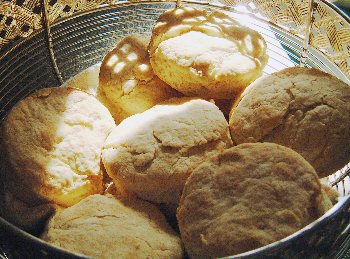
I discovered that if I wanted biscuits on a regular basis, I had better learn to make them myself. This recipe is easy and quick; there's no reason not to make them from scratch.
- Carbohydrate 192.16909516 g
- Cholesterol 28.50962228 mg
- Fat 48.42419889 g
- Fiber 7.56800011955202 g
- Protein 26.4070671 g
- Saturated Fat 19.1009964355 g
- Serving Size 1 1 Dozen (350g)
- Sodium 4100.689167 mg
- Sugar 184.601095040448 g
- Trans Fat 2.82114488199999 g
- Calories 1325 calories
Step-by-step
- Preheat the oven to 425°F.
- Mix all the dry ingredients together in a bowl.
- With a pastry blender, or two knives cut the shortening into the dry mixture until it has the consistency of coarse cornmeal. (I've seen this done with two butter knives, but personally, I'd be lost without a pastry blender!) Add the milk while gently stirring with a fork. The dough that forms should be soft, but not sticky. You may have to add a little more or less depending on the temperature and humidity of your kitchen. You'll have to experiment until you learn the "feel" of the dough. Knead the dough on a floured board until smooth. DO NOT OVERWORK! Overworked biscuits will be tough! A friend of mine once said "Just flip it over and smack it twice . . . .don't work it no more!" Roll out the dough, or pat it flat. Cut with a biscuit cutter or a glass tumbler and place on a lightly greased baking sheet about 1 inch apart. This recipe makes about a dozen biscuits about 3 inches across and a half inch tall (unbaked). You can make them thicker, of course, but remember that they will rise up as they bake. Bake 12-15 minutes, or until golden brown.
- Serve these with Frank's Famous Sausage Gravy . . . but you had better make a double batch! You wouldn't want to make that combo every day, though . . . too much fat and cholesterol!
Fat Selection and Chemical Texture
Replacing shortening with salted butter changes the melting point and moisture content significantly, yielding a denser crumb because butter contains water that evaporates during baking. Shortening melts at a higher temperature, trapping steam inside solid pockets to create distinct flaky layers. A pastry blender cuts this fat into the dry ingredients efficiently without transferring hand heat, which would otherwise melt the fat prematurely.Leavening Interactions and Liquid Absorption
Baking powder reacts twice: first upon contact with the liquid milk, and second when exposed to the 425 degrees Fahrenheit oven heat. Stirring gently with a fork prevents gluten strands from developing excessively. Kitchen humidity dictates the exact amount of liquid required, meaning bakers must gauge the dough by feel until it forms a soft, non-sticky mass.Handling Limits and Baking Physics
Overworking the dough creates tough, rubbery results by overdeveloping wheat proteins. Kneading should stop the moment the surface turns smooth. Spacing the cut pieces one inch apart on the baking sheet allows adequate heat circulation for 12 to 15 minutes until the exterior turns golden brown.


