Challah
Indulge in traditional egg bread, perfect for celebratory occasions, with a touch of sweetness from raisins or golden raisins.
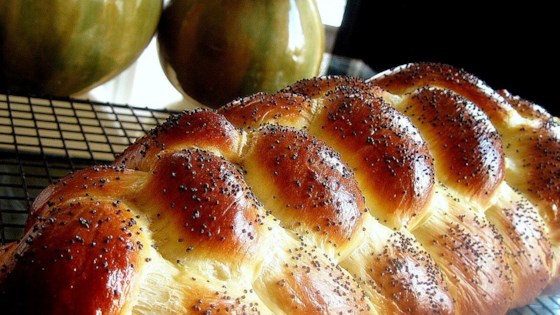
Indulge in traditional egg bread, perfect for celebratory occasions, with a touch of sweetness from raisins or golden raisins.
- Carbohydrate 34.4266546719663 g
- Cholesterol 18.612 mg
- Fat 2.46212933357071 g
- Fiber 1.88985002036008 g
- Protein 5.88486566849843 g
- Saturated Fat 0.334493991702731 g
- Serving Size 1 1 Serving (72g)
- Sodium 9.60326666947305 mg
- Sugar 32.5368046516062 g
- Trans Fat 0.268203491732209 g
- Calories 184 calories
Step-by-step
- In a large bowl, sprinkle yeast over barely warm water.
- Beat in honey, oil, 2 eggs, and salt.
- Add the flour one cup at a time, beating after each addition, graduating to kneading with hands as dough thickens.
- Knead until smooth and elastic and no longer sticky, adding flour as needed.
- Cover with a damp clean cloth and let rise for 1 1/2 hours or until dough has doubled in bulk.
- Punch down the risen dough and turn out onto floured board.
- Divide in half and knead each half for five minutes or so, adding flour as needed to keep from getting sticky.
- Divide each half into thirds and roll into long snake about 1 1/2 inches in diameter.
- Pinch the ends of the three snakes together firmly and braid from middle.
- Either leave as braid or form into a round braided loaf by bringing ends together, curving braid into a circle, pinch ends together.
- Grease two baking trays and place finished braid or round on each.
- Cover with towel and let rise about one hour.
- Preheat oven to 375 degrees F (190 degrees C).
- Beat the remaining egg and brush a generous amount over each braid.
- Sprinkle with poppy seeds if desired.
- Bake at 375 degrees F (190 degrees C) for about 40 minutes.
- Bread should have a nice hollow sound when thumped on the bottom.
- Cool on a rack for at least one hour before slicing.
Overkneading enriched yeast dough ranks as the primary error home bakers commit when tackling traditional egg bread. Flour requires careful incremental additions during the initial mixing phase, transitioning from liquid batter to a smooth mass only when gluten strands develop sufficiently to hold elasticity without tearing. Water temperature must remain strictly around 110 degrees Fahrenheit to activate dry yeast safely without thermal shock. Honey and vegetable oil tenderize the crumb significantly, yet too much flour incorporated during the final bench kneading yields a dense, heavy loaf rather than an airy structure. Patience dictates success during the primary ninety-minute fermentation stage, where doubling in bulk signals optimal biochemical activity. Dividing the risen mass into precise portions for braiding ensures even heat penetration during baking. Brushing the shaped loaves with a beaten egg wash before baking creates a glossy, deep amber crust, while poppy seeds provide a mild crunch. Baking at 375 degrees Fahrenheit for approximately forty minutes requires verification through a hollow sound when tapping the bottom crust. Cooling the finished bread on a wire rack for a minimum of sixty minutes prevents internal steam from condensing and gummy textures from forming before slicing. Pair slices with salted butter or sharp cheeses to balance the natural sweetness derived from honey.



