Pecan Pralines
As close as I could make them to what you can find on River Street in Savannah, Georgia.
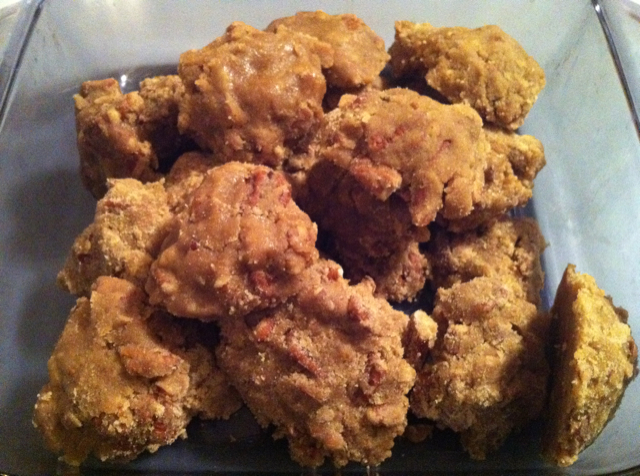
As close as I could make them to what you can find on River Street in Savannah, Georgia.
- Carbohydrate 112.069215 g
- Cholesterol 19.50925 mg
- Fat 22.1978245 g
- Fiber 2.0928000831604 g
- Protein 3.7838295 g
- Saturated Fat 5.419348 g
- Serving Size 1 1 Serving (160g)
- Sodium 64.1418 mg
- Sugar 109.97641491684 g
- Trans Fat 1.1561557 g
- Calories 638 calories
Step-by-step
- Combine both sugars, the vanilla and the evaporated milk in a saucepan.
- Heat to 230 degrees (just below soft ball stage). Stir frequently so sugar does not burn.
- Add the butter and continue to heat and stir until the mixture reaches 250 degrees (the temperature is very important).
- Remove from the heat and stir in the pecans. Continue to stir until the mixture begins to cool and thickens.
- Spoon out onto wax paper to cool. If the mixture thickens to much while spooning it out, heat just until it is soft enough again.
Reaching exactly 250 degrees Fahrenheit marks the critical juncture where crystalline structure transforms completely from a grainy slurry into smooth, creamy candy. Confectioners on River Street in Savannah rely on this precise thermal threshold to drive off excess moisture while maintaining sucrose suspension. Evaporated milk provides concentrated dairy proteins that prevent immediate graining, anchoring the massive volume of refined white and light brown sugars through the boiling phase.
The Chemistry of Sucrose Crystallization
Sugar molecules demand absolute discipline during heating because early agitation triggers premature recrystallization, ruining the texture before the butter ever enters the pan. Stirring frequently while climbing from the initial 230-degree soft ball stage ensures even heat distribution without scorching the milk solids on the bottom of the vessel. Introducing cold butter at the higher temperature drops the thermal momentum slightly, creating an emulsion of milk fat that coats the sugar crystals and yields a characteristic velvety bite when cooled.
- Heat the initial sugar and milk base steadily while stirring to prevent localized scorching at the bottom of the saucepan.
- Monitor the candy thermometer constantly because failing to hit the exact 250-degree mark results in sticky, unmanageable syrup rather than firm pralines.
- Stir vigorously after removing the pot from the burner to encourage controlled micro-crystallization as the temperature drops.
- Warm the mixture gently if it thickens excessively in the pot before finishing spooning portions onto wax paper.



