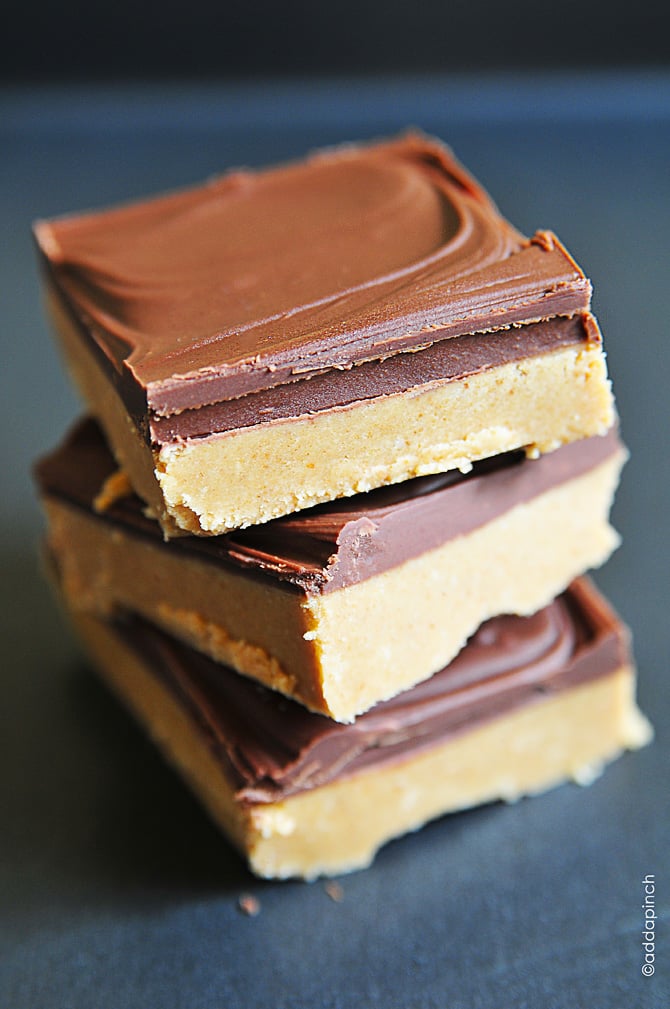
These peanut butter bars offer the delicious taste of peanut butter cups.
- Carbohydrate 55.8870376167829 g
- Cholesterol 40.6708333851558 mg
- Fat 23.3302198190795 g
- Fiber 1.41462500457272 g
- Protein 3.25352604429641 g
- Saturated Fat 12.5071306405581 g
- Serving Size 1 1 Serving (87g)
- Sodium 226.027396008795 mg
- Sugar 54.4724126122102 g
- Trans Fat 1.40553448082105 g
- Calories 430 calories
Step-by-step
- In a medium bowl, mix together the butter or margarine, graham cracker crumbs, confectioners' sugar, and 1 cup peanut butter until well blended. Press evenly into the bottom of an ungreased 9x13 inch pan.
- In a metal bowl over simmering water, or in the microwave, melt the chocolate chips with the peanut butter, stirring occasionally until smooth. Spread over the prepared crust. Refrigerate for at least one hour before cutting into squares.
Commercial confections rely on shelf-stable emulsifiers and fractionated fats to maintain rigidity at room temperature. Freshly made versions depend entirely on the moisture content of natural fats and the hygroscopic nature of milled sugar. Using freshly ground peanut butter instead of a homogenized commercial jar introduces unblended oils that separate quickly, altering the density of the crumb base. Standard commercial peanut butter contains hydrogenated vegetable oils that prevent this separation. When substituting natural styles, stir the oil thoroughly until the mixture reaches a uniform viscosity before combining it with the butter and dry ingredients. Graham cracker crumbs absorb ambient humidity rapidly. Storing the finished squares in an airtight container lined with parchment paper prevents condensation from softening the crust during the mandatory one-hour refrigeration window. Melting chocolate chips requires gentle heat control. Direct contact with temperatures exceeding 120 degrees Fahrenheit causes cocoa butter crystals to seize into a dull, grainy mass. Utilize a double boiler with simmering water rather than a rolling boil, ensuring the metal bowl never touches the water directly. Alternatively, microwave the chocolate in thirty-second increments at half power, stirring vigorously between intervals to distribute thermal energy evenly. Scaling this formulation requires precise mathematical ratios. Halving the proportions fits neatly into an 8x8 inch baking dish without altering the chilling duration. Doubling the batch for larger yields necessitates dividing the chocolate topping into two separate melting phases to prevent premature hardening during the spreading process. Cut the chilled slab with a sharp, thin-bladed knife wiped clean between slices to achieve sharp geometric edges.



