Flaky Apple Turnovers
These gorgeous sugar crystal-encrusted, flaky turnovers are made from scratch using a simplified quick puff pastry technique. We're talking about seriously good here -- crisp on the outside, flaky, moist, buttery pastry, just firm enough, not too sweet, with just a little tang from added sour cream, apples that have been cooked and caramelized before filling the pastry, and just the right ratio of pastry to apples. Simply the absolute best turnovers I have ever made. The pastry for these turnovers is actually quite easy to make. However, even though simplified, the making of pastry and turnovers is still a little time-consuming. But most of the time is spent just waiting, and the actual work/prep steps are minimal and pretty straightforward. Still, you may wish to make the dough one day, and the turnovers the next. This recipe also lends itself very well to just about any other fruit or fruit/cheese combination you can think of.
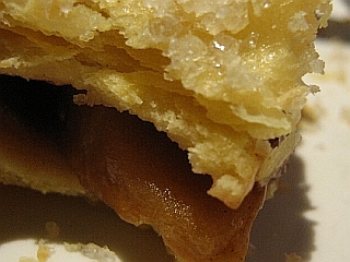
These gorgeous sugar crystal-encrusted, flaky turnovers are made from scratch using a simplified quick puff pastry technique. We're talking about seriously good here -- crisp on the outside, flaky, moist, buttery pastry, just firm enough, not too sweet, with just a little tang from added sour cream, apples that have been cooked and caramelized before filling the pastry, and just the right ratio of pastry to apples. Simply the absolute best turnovers I have ever made. The pastry for these turnovers is actually quite easy to make. However, even though simplified, the making of pastry and turnovers is still a little time-consuming. But most of the time is spent just waiting, and the actual work/prep steps are minimal and pretty straightforward. Still, you may wish to make the dough one day, and the turnovers the next. This recipe also lends itself very well to just about any other fruit or fruit/cheese combination you can think of.
- 1 teaspoon salt
- 1/2 teaspoon ground cinnamon
- pinch of salt
- 1/4 teaspoon ground ginger
- 1/4 teaspoon ground allspice
- 1/2 cup sugar
- 1 cup cake flour
- == dough ==
- 1 cup sour cream, cold
- 3 cups unbleached all-purpose flour
- 1 1/2 cups unsalted butter (3-sticks), very cold, cut into small pieces
- == filling ==
- 4 large apples peeled, cored, cut into small pieces (about 2 lbs), (i mix jonagold & granny smith)
- 1/2 vanilla bean, split and scraped
- 2 to 4 tablespoons fresh lemon juice
- 1/4 cup unsalted butter (1/2-stick)
- == egg wash ==
- 1 large egg beaten with 1 teaspoon of water
- sanding sugar, for dusting (a coarse crystal baker's sugar)
- Carbohydrate 83.87211453125 g
- Cholesterol 71.49921875 mg
- Fat 22.964953125 g
- Fiber 2.50289226256311 g
- Protein 6.07482921875 g
- Saturated Fat 14.1547015625 g
- Serving Size 1 1 Serving (189g)
- Sodium 18.684765625 mg
- Sugar 81.3692222686869 g
- Trans Fat 1.76420315625 g
- Calories 557 calories
Step-by-step
- In a small bowl, whisk together sour cream and sugar; set aside.
- In a large bowl, whisk together all-purpose flour, cake flour, and salt.
- Add butter pieces and toss until coated with flour.
- Cut butter in with pastry blender, two knives, or rub in with your fingertips until mixture forms an irregular coarse meal, with still visible pieces of butter.
- Don't overworked dough.
- Make a well in center of mixture and add sour cream.
- Use a fork in a lifting and tossing motion to gently blend sour cream with flour mixture, mixing just until a rough, very soft and sticky dough is formed.
- (If mixture doesn't come together or is at all dry, add a little more sour cream or cold water.)
- Divide dough in half and turn out each half onto a piece of plastic wrap.
- Using the plastic wrap, push and pat dough to form into rough rectangles.
- Wrap in plastic wrap and refrigerate for at least 1 hour, or up to 2 days.
- Remove a rested piece of dough from refrigerator and place on a lightly floured work surface.
- Sprinkle dough with as little flour as necessary to prevent sticking, and roll it out into a 9-by-18-inch rectangle about 1/2-inch thick (dimensions aren't that important--a rough rectangle shape is fine).
- With one of the narrow edges facing you, do a sigle turn on the dough (a single turn creates 3 layers of dough).
- Fold the bottom third of the dough up over the middle third, then fold the top third down over the these two layers (so all 3 layers are stacked on top of each other).
- Wrap dough tightly in plastic wrap and refrigerate.
- Repeat process with second piece of dough.
- Refrigerate dough for at least 2 hours, or up to 2 day, or freeze for up to 1 month.
- In a large bowl, whisk together sugar, cinnamon, ginger, allspice and salt.
- Add apples, vanilla seeds and lemon juice, and toss to coat.
- Melt butter in a large skillet over medium heat until it turns a light nutty color, about 6 to 8 minutes.
- Add apple mixture and saute until apples are slightly softened and caramelize, about 10 to 12 minutes.
- Transfer cooked apples to a baking sheet and let cool completely before forming turnovers.
- Cooled filling can be stored in refrigerator for up to 3 days.
- Line two baking sheets with parchment paper or silicone mats.
- Remove a piece of dough from refrigerator and place on a lightly floured work surface.
- Roll out dough to a thickness of about 1/8- to 3/16-inch.
- Cut out 4 1/2-inch rounds with a large cutter.
- Repeat with second piece of dough.
- Gather up all of the scraps, press scaps together, wrap in plastic and refrigerate for 30 minutes, then reroll and cut out additional rounds, if desired.
- (I find that turnovers made from the scraps are still flaky and taste just as good!)
- Place 1 to 2 tablespoons of apples in center of each round.
- Using a pastry brush, apply a thin coat of water to lower half of each round.
- Fold top half of dough down over filling and gently press edges together.
- Seal edges by crimping with tines of fork.
- Use fork to poke steam vents into each turnover.
- (At this point, turnovers can be frozen, wrapped tightly in plastic wrap when firm, and stored in freezer for up to 1 month.)
- Using wide metal spatula, carefully transfer turnovers to prepared baking sheets, spacing them about 1-inch apart.
- Chill filled turnovers for 30 minutes, or cover with plastic and refrigerate up to 24 hours.
- Adjust oven racks to upper and lower third positions and preheat the oven to 400 degrees F.
- Using a pastry brush, apply a thin coat of egg wash to tops of turnovers and sprinkle with sanding sugar.
- Bake for 10 minutes.
- Rotate baking sheets from top to bottom and front and back, reduce oven temperature to 350 degrees F, and bake for another 10 to 15 minutes, or until puffed, firm to the touch, and golden brown.
- Using a wide metal spatula, transfer turnovers to wire rack to cool.
- Serve warm or at room temperature.
- Store in an airtight container for up to 24 hours.



