Blueberry Sourdough Scones
In baking school I learned that freezing scones prior to baking makes the dough easier to cut and helps them retain their shape during baking. At home I learned that it is also a great way to have freshly-baked scones for Sunday morning breakfast. I baked these in my minimalist sometime-weekend-kitchen. By minimalist I mean a kitchen in a town whose one market doesnt carry parchment paper a kitchen whose oven temperature I can only guess at where you make do with the ingredients you have where fingers substitute for a pastry brush where the ellipsis has free rein But I still have the best 25-year-old Robot Coupe food processor in the world. A food processor is not absolutely necessary, but it makes short work of cutting the butter into the dry ingredients. The sourdough starter in these scones is more for flavor than leavening. I suggest letting your starter ferment a little past its peak to a more liquid consistency this makes it easier to incorporate it into the dough. Mixing only to incorporation is important to avoid gluten development and maintain the scones crumbly texture. I fresh used blueberries, but other berries, cherries, or chopped stone fruits would also be nice, and frozen works, too. Placing them in the bottom of the pan (which will become the top) rather than mixing it into the dough keeps fragile fruit from disintegrating in the mixing process. A concentration of fruit on top also gives a visual punch to the scones.
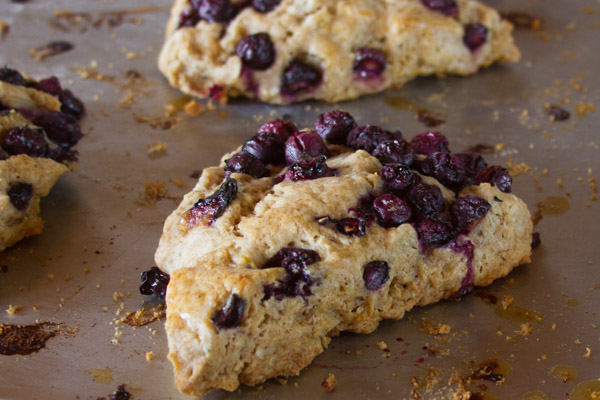
In baking school I learned that freezing scones prior to baking makes the dough easier to cut and helps them retain their shape during baking. At home I learned that it is also a great way to have freshly-baked scones for Sunday morning breakfast. I baked these in my minimalist sometime-weekend-kitchen. By minimalist I mean a kitchen in a town whose one market doesnt carry parchment paper a kitchen whose oven temperature I can only guess at where you make do with the ingredients you have where fingers substitute for a pastry brush where the ellipsis has free rein But I still have the best 25-year-old Robot Coupe food processor in the world. A food processor is not absolutely necessary, but it makes short work of cutting the butter into the dry ingredients. The sourdough starter in these scones is more for flavor than leavening. I suggest letting your starter ferment a little past its peak to a more liquid consistency this makes it easier to incorporate it into the dough. Mixing only to incorporation is important to avoid gluten development and maintain the scones crumbly texture. I fresh used blueberries, but other berries, cherries, or chopped stone fruits would also be nice, and frozen works, too. Placing them in the bottom of the pan (which will become the top) rather than mixing it into the dough keeps fragile fruit from disintegrating in the mixing process. A concentration of fruit on top also gives a visual punch to the scones.
- 50 gramsâ flour
- 130 grams whole wheat flour
- 6.8 grams (1 1/2 teaspoons) baking powder
- 1.8 grams (1/2 teaspoon) baking soda
- 3.8 grams (5/8 teaspoon) salt
- 50 grams brown sugar
- 113 grams (1 stick) cold unsalted butter
- 40 grams rolled oats
- 50 grams half and half
- 244 g mature 100%-hydration sourdough starter
- Carbohydrate 170.466 g
- Cholesterol 0 mg
- Fat 5.039 g
- Fiber 19.8999999046326 g
- Protein 23.13 g
- Saturated Fat 0.8626 g
- Serving Size 1 1 Recipe (464g)
- Sodium 22.9 mg
- Sugar 150.566000095367 g
- Trans Fat 1.1501 g
- Calories 782 calories
Step-by-step
- Line an 8-inch cake pan with lightly-buttered plastic wrap. Place the blueberries in the pan.
- In the bowl of a food processor, place the flours, whole wheat flour, baking powder, baking soda, salt, and brown sugar. Pulse a few times to combine.
- Cut the cold butter into 1/2-inch cubes. Pulse them with the dry ingredients in the food processor until the largest pieces of butter are the size of small peas.
- Transfer the mixture to a bowl. Toss in the oats lightly with a spatula.
- Add the half and half and the starter and mix lightly with your hands until just barely incorporated.
- Press the dough into the pan over the berries.
- Cover the top of the pan with plastic wrap and freeze overnight, or for at least four hours.
- Unmold the frozen scone round. Use a sturdy knife to cut the round into 8 wedges.
- Transfer the scones to a buttered or parchment-lined baking sheet. Let them stand until slightly thawed, about 30 minutes.
- Meanwhile, preheat the oven to 400F.
- Make an egg wash by beating the egg together with a splash of water and a pinch of salt. Just before baking, brush the tops and sides of the scones lightly with the egg wash.
- Bake for about 30 minutes, or until the scones are set and lightly browned.
- Enjoy while warm!
Scones emerge from a 400-degree oven with a deeply browned crust and a tender, crumbly crumb that yields easily to the bite. Mature sourdough starter provides complex acidity rather than primary levaning power, while chemical leaveners supply the necessary lift. Letting the starter ferment past its peak yields a more liquid consistency, which distributes moisture evenly throughout the dry ingredients without requiring excessive stirring. Overworking the dough develops unwanted gluten strands that toughen the texture. Cubing the cold butter into half-inch pieces before processing ensures that solid fat pockets remain intact, creating steam channels as the butter melts during baking. Freezing the shaped dough round for at least four hours solidifies these fats completely, allowing a sturdy knife to cut clean wedges without compressing the layers. Placing berries at the base of the pan before pressing the dough over them protects fragile fruit from bursting during initial mixing. Fresh blueberries can be swapped for frozen berries, chopped stone fruits, or cherries without altering the liquid ratio. Brushing an egg wash made with a pinch of salt over the exterior surfaces just before baking promotes even browning through the Maillard reaction. Letting the frozen wedges rest for thirty minutes at room temperature tempers the chill just enough for the chemical leaveners to activate efficiently once thermal heat hits the baking sheet.



