Mel's Kitchen Cafe: The Best Refried Beans (Slow Cooker and Fat-Free)
But never, and I repeat never, have I ever in a million years double dipped a spoon into a jar/can of refried beans for a solo taste. I mean, have you? Gross. To be perfectly honest refried-beans-in-a-can have always kind of icked me out big time. All that changed, though, after I made my very own homemade refried beans.
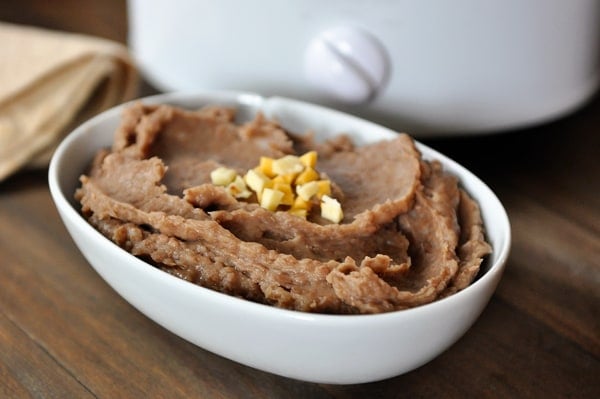
But never, and I repeat never, have I ever in a million years double dipped a spoon into a jar/can of refried beans for a solo taste. I mean, have you? Gross. To be perfectly honest refried-beans-in-a-can have always kind of icked me out big time. All that changed, though, after I made my very own homemade refried beans.
- 1 teaspoon salt
- salt to taste
- 1 pound dry pinto beans, rinsed remove any stones or shriveled beans
- 1 medium white or yellow onion peeled and cut into large chunks
- 4 cloves garlic, peeled and smashed
- 1 green jalapeno pepper seeded and membranes removed, chopped
- 1 tablespoon white vinegar or same amount of liquid from a jar of jalapenos or banana peppers
- Carbohydrate 36.3957484293753 g
- Cholesterol 0 mg
- Fat 0.720748268875 g
- Fiber 8.88985216553135 g
- Protein 12.32756070675 g
- Saturated Fat 0.1365527586875 g
- Serving Size 1 1 Serving (65g)
- Sodium 733.996135550016 mg
- Sugar 27.505896263844 g
- Trans Fat 0.2109295760375 g
- Calories 201 calories
Step-by-step
- Place the rinsed beans in a medium or large saucepan and cover with water by at least an inch. Bring the beans and water to a boil and cover, cooking for 15 minutes (be aware that the beans will expand as they absorb water and cook so make sure your pan isn't overly full to begin with or else you'll have an overflow problem - safest to start with a larger pot).
- Remove from the heat and drain the beans. Place the beans in the slow cooker insert and cover them with about 2 inches of water. Add the salt, onion, garlic, and jalapeno. Cover and cook on high for 4-6 hours. I haven't tried it but you could experiment by cooking on low for 8-10 hours.
- When the beans are tender, ladle out about 1 to 1 1/2 cups of the cooking liquid and reserve in a bowl or liquid measuring cup. Drain the beans and veggies in a colander until most of the liquid is gone but there are still a few drips (you don't want the beans bone dry).
- Place the beans and veggies and 1 tablespoon white vinegar (or 1 tablespoon liquid from a jar of jalapenos) in a food processor or blender (you may need to do this in batches - if so, only use half the amount of vinegar each time if splitting the beans in two batches).
- Depending on how well you drained the beans, add about 1/4 cup liquid (more if needed) and process until the desired texture is reached - I like mine mostly smooth with a little bit of beans for texture. Add more liquid if needed. I have found I don't need to add a whole lot of reserved liquid if I've lightly drained the beans and they are still wet. Most importantly, taste the beans and add additional salt, if needed!
- I let the refried beans cool and then spoon them in 1-2 cup amounts into freezer ziploc bags, press them flat, remove as much air as possible and seal.
Dried pinto beans do not carry their own flavor profile until aromatics and sodium penetrate their cellular walls during the initial hot-water phase. When scaling this recipe upward, remember that a standard 5-quart round slow cooker restricts proper heat distribution for two pounds of legumes, requiring an oval insert of at least six quarts to prevent uneven softening.
Scaling and Equipment Mechanics
Doubling dry pinto beans means doubling the onion, garlic, and jalapeno without necessarily doubling the salt linearly, because salt concentration behaves differently in larger volumes of soaking water. If you drop the quick-boil step in favor of an overnight soak in cold water, ensure the liquid level sits one to two inches above the beans to allow for maximum starch hydration before the slow cooker turns on. Processing the cooked legumes requires retaining some cooking liquid; blend them in batches while adding liquid a quarter-cup at a time until the blade creates a vortex that yields a smooth yet structurally varied puree.
Freezing and Preservation Protocols
Flattening cooked beans into ziploc freezer bags expels trapped oxygen that causes freezer burn, establishing a safe storage window of several months. Over-salting at the beginning of the cook cycle is the single most common error cooks make, which concentrates harshly as moisture evaporates over four to six hours on high heat. Always reserve your extraction liquid before dumping the colander contents, because adjusting moisture content at the puree stage dictates whether the final texture turns out gluey or creamy.



