Macadamia Popcorn
Iola Egle of Bella Vista, Ark., an avid cook, has several of her own cookbooks. This recipe was given to her by a special friend, Barb Wiemers of McCook, Neb., many years ago. Her family loves the recipe, and one bag of popcorn isn't enough when they're together. She often makes part of it with white almond bark and half with chocolate almond bark. The recipe is a special treat and can be adapted for different holidays. She has even used red hots for Valentine's Day or cocktail peanuts instead of macadamia nuts for a more cost-effective option. Cooking is a fun project for her, where she enjoys planning menus and preparing meals for guests.
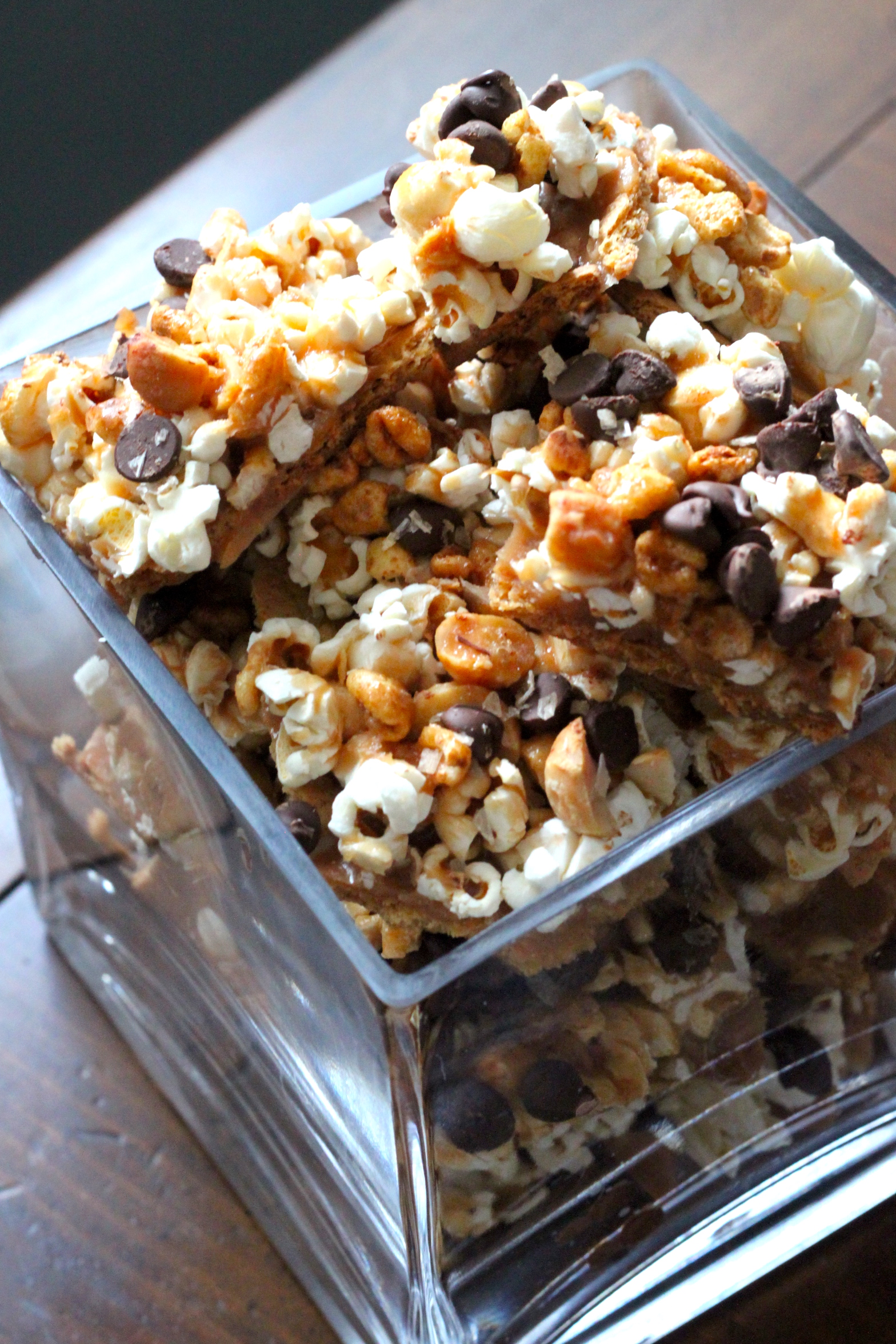
Iola Egle of Bella Vista, Ark., an avid cook, has several of her own cookbooks. This recipe was given to her by a special friend, Barb Wiemers of McCook, Neb., many years ago. Her family loves the recipe, and one bag of popcorn isn't enough when they're together. She often makes part of it with white almond bark and half with chocolate almond bark. The recipe is a special treat and can be adapted for different holidays. She has even used red hots for Valentine's Day or cocktail peanuts instead of macadamia nuts for a more cost-effective option. Cooking is a fun project for her, where she enjoys planning menus and preparing meals for guests.
- Carbohydrate 15.17266476312 g
- Cholesterol 0 mg
- Fat 86.27326869792 g
- Fiber 9.071847392 g
- Protein 8.83371139796 g
- Saturated Fat 13.547670099028 g
- Serving Size 1 1 Recipe (454g)
- Sodium 4.535923696 mg
- Sugar 6.10081737112 g
- Trans Fat 3.81017590464 g
- Calories 814 calories
Step-by-step
- Mix nuts and popcorn.
- Pour melted white bark over them.
- Spread out on waxed paper on jelly roll pan to dry.
- Break apart.
Ingredient weights and volumes rarely explain how a batch behaves once the fat hits the starch, particularly when dealing with moisture-sensitive components like popped corn. White chocolate morsels and almond bark melt at different thresholds, with compound coatings containing vegetable oils melting smoothly around 110 degrees Fahrenheit, whereas real chocolate requires careful tempering to avoid gray streaks known as fat bloom. Controlling this initial heat ensures the coating remains fluid enough to distribute evenly over the kernels without scorching the delicate sugars.
Scaling this formulation up or down requires maintaining a precise surface area ratio rather than simply doubling quantities linearly. A single standard microwave bag yields roughly ten to twelve cups of popped kernels, which demands at least twelve ounces of melted coating to achieve a complete shell without leaving dry spots. Spreading the mixture across a rimmed jelly roll lined with waxed paper prevents pooling at the bottom, allowing air circulation to set the fat within twenty minutes at room temperature.
Texture depends entirely on keeping ambient humidity away from the freshly popped starch. Moisture transforms crisp hulls into a chewy, undesirable mass within hours, meaning the drying phase must occur in a climate-controlled room where relative humidity stays below fifty percent. Incorporating crushed macadamia nuts introduces high fat content that adds structural crunch, though unevenly chopped pieces can sink through the liquid chocolate and pool on the waxed paper.
Storage containers must feature airtight seals to preserve the brittle snap of the hardened coating for up to seven days. Placing parchment paper between stacked layers prevents the pieces from fusing into a solid block during storage. If the ambient temperature exceeds seventy-two degrees, transfer the sealed container to the refrigerator temporarily to prevent the confection from softening.



