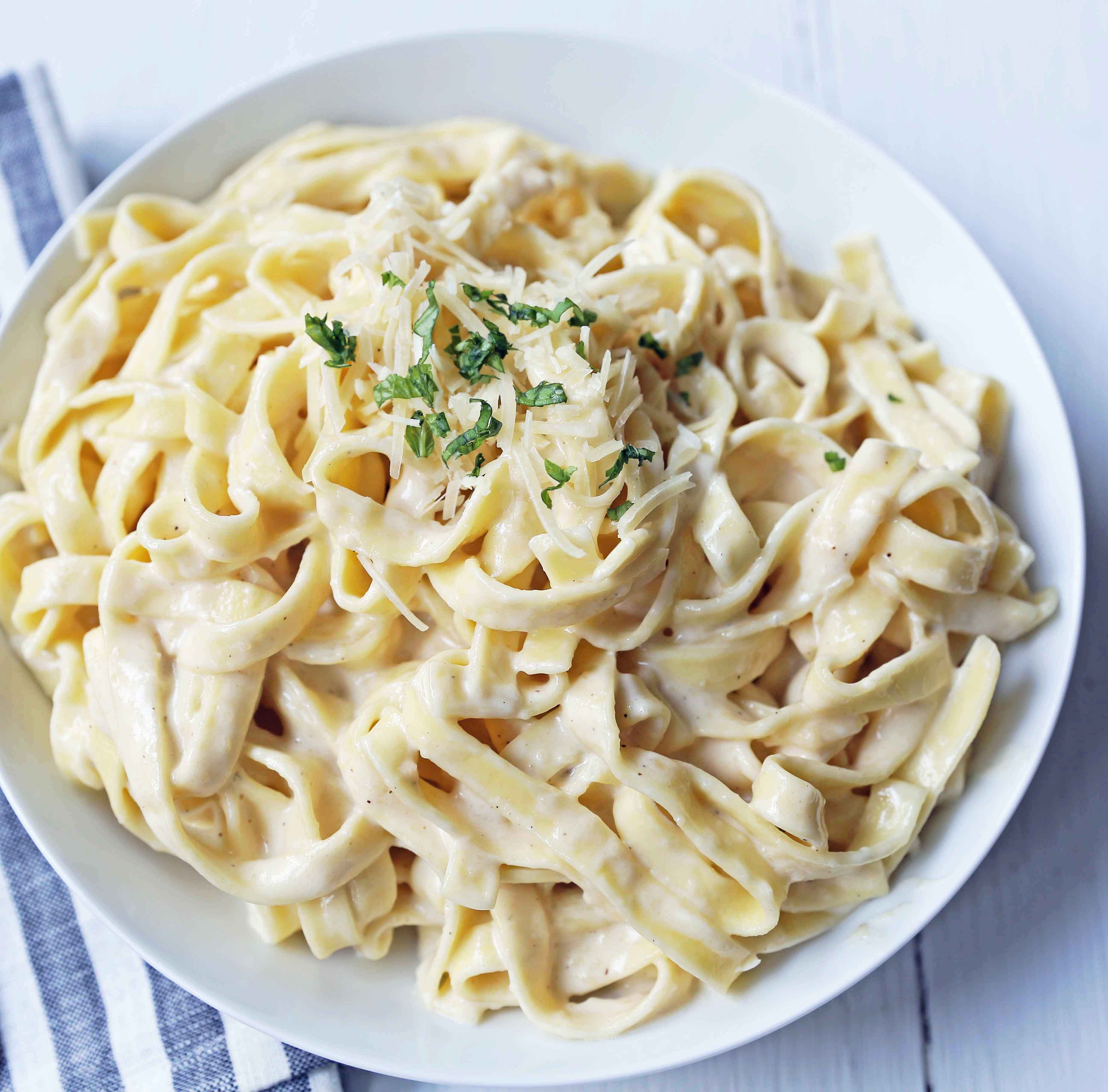
Try this Pasta Alfredo recipe, or contribute your own.
- Carbohydrate 18.09052 g
- Cholesterol 537.98 mg
- Fat 178.89154 g
- Fiber 1.50279995012283 g
- Protein 62.83468 g
- Saturated Fat 111.449069 g
- Serving Size 1 1 Serving (440g)
- Sodium 3157.64 mg
- Sugar 16.5877200498772 g
- Trans Fat 11.445028 g
- Calories 1908 calories
Step-by-step
- Boil the water for the pasta (Ive been using angel hair, and Im terrible at measuring it -- the sauce is enough for 2-3 servings I think).
- Add pasta when it starts boiling.
- Melt the butter in a large pan, saute garlic until it looks soft.
- Add cream, parsley, onion powder, red pepper, black pepper and salt.
- Stir until is is almost boiling.
- Gradually add cheese and stir.
- I usually add a little Arrowroot to thicken the sauce.
- Drain the pasta (if you havent already) and toss it with the sauce.
- Serve topped with a little cheese and parsley.
Traditional fettuccine Alfredo relies exclusively on starchy pasta water and hard cheese to build an emulsion, but heavy cream changes the physics entirely. Introducing dairy fat and liquid creates a stable suspension that coats pasta differently than butter and water alone. Sautéing minced garlic in butter at a medium-low heat for roughly two minutes releases fat-soluble flavor compounds without browning the allium. Burning the garlic introduces bitter pyrazines that will ruin the dairy base immediately. Whisking heavy cream, onion powder, and red pepper into the pan requires maintaining a gentle heat just beneath a rolling boil to prevent the proteins in the cream from curdling under high thermal shock. Adding freshly grated parmesan gradually ensures the melting proteins and fats integrate uniformly into the liquid rather than clumping into a greasy mass. Aged parmesan contains sodium caseinate and glutamates that thicken the reduction naturally as moisture evaporates. Incorporating a thickening agent like arrowroot requires whisking it thoroughly into cool liquid first to prevent gelatinized lumps from forming in the hot pan. Tossing the drained pasta directly into the sauce within sixty seconds of draining maximizes starch absorption, anchoring the heavy emulsion to the strands. Pairing this rich, high-fat carbohydrate dish with a bitter green salad dressed in a sharp acidic vinaigrette cuts through the coating butter and clears the palate between bites.



