Basil Pesto Bread
I have now lost the original recipe for this, but that is okay. It called for a lengthy process that included stuffing the bread with a fresh pesto sauce. We all know now that I do not have the patience for stuff like that, so I throw it all in one bowl & let it be easy!
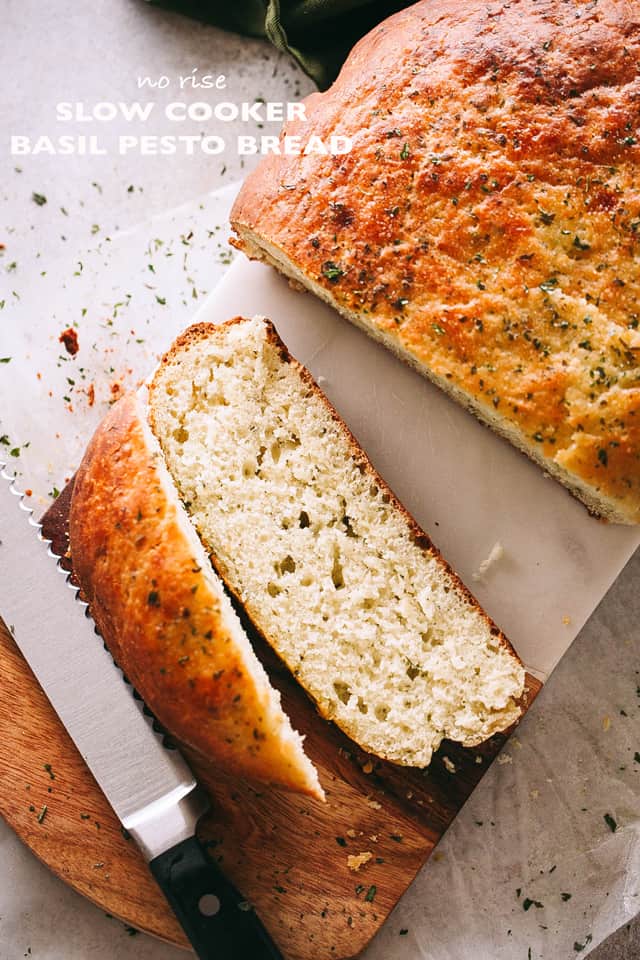
I have now lost the original recipe for this, but that is okay. It called for a lengthy process that included stuffing the bread with a fresh pesto sauce. We all know now that I do not have the patience for stuff like that, so I throw it all in one bowl & let it be easy!
- Carbohydrate 75.6831058485893 g
- Cholesterol 1.51014318781469 mg
- Fat 4.94752480988687 g
- Fiber 3.48985004679362 g
- Protein 10.9796345492805 g
- Saturated Fat 0.941552749534644 g
- Serving Size 1 1 Serving (152g)
- Sodium 31.4527378882803 mg
- Sugar 72.1932558017957 g
- Trans Fat 0.44245785780767 g
- Calories 395 calories
Step-by-step
- Turn on oven light.
- In a stand mixer fitted with a flat beater, mix half of the flour with the yeast, sugar, & salt.
- Add the water, olive oil, basil, cheese, & garlic.
- Mix, adding more flour 1/4 cup at a time, until the dough forms a shaggy mass.
- Remove flat beater & attach dough hook.
- Knead dough with dough hook about 8 minutes, adding remaining flour when dough becomes sticky (this dough will remain a little sticky).
- Cover mixer bowl & place in oven until dough doubles in bulk (about 20 minutes).
- Punch dough down, divide in half, shape into two loaves, & place in greased loaf pans.
- Cover pans & place in oven to rise until dough reaches the top of the pan (20 to 40 minutes).
- Remove covering from pans & heat oven to 375?.
- Bake loaves 40 to 50 minutes.
- Let cool in pans about 10 minutes.
Swapping all-purpose flour for whole wheat changes the hydration needs of the dough significantly because bran absorbs more moisture than refined white flour. Small spaces demand efficient workflows, and mixing all the flavor elements directly into the dough bypasses the tedious process of layering fillings by hand. Combining fresh basil, grated parmesan, and pressed garlic right in the initial bowl distributes the aromatics evenly throughout the gluten network without requiring a separate food processor.
Assessing structural readiness relies on physical observation rather than digital tools. Tap the bottom of the baked loaf. A hollow sound indicates a fully set crumb, while a dull thud means the interior remains dense and wet. Allowing the bread to rest in the metal pan for precisely ten minutes completes the internal starch setting before transferring the loaf to a wire cooling rack.
Dividing the ingredient quantities in half adapts this two-loaf yield easily for a single standard 8-by-4-inch loaf pan. Baking time remains largely consistent even when halving proportions, though monitoring the crust color past the thirty-minute mark prevents over-browning.



