Slow Cooker Potato Soup
This might be the easiest dinner I've ever made. My husband was concerned that it was too thick, but I was more concerned that it would be bland. Well, it turned out that neither of us had anything to worry about. The mixture magically transformed into a wonderfully delicious bowl of soup. We both loved it. We topped the soup with some bacon bits, cheese and sour cream. I would have added green onions, but I didn't have any. Next time!
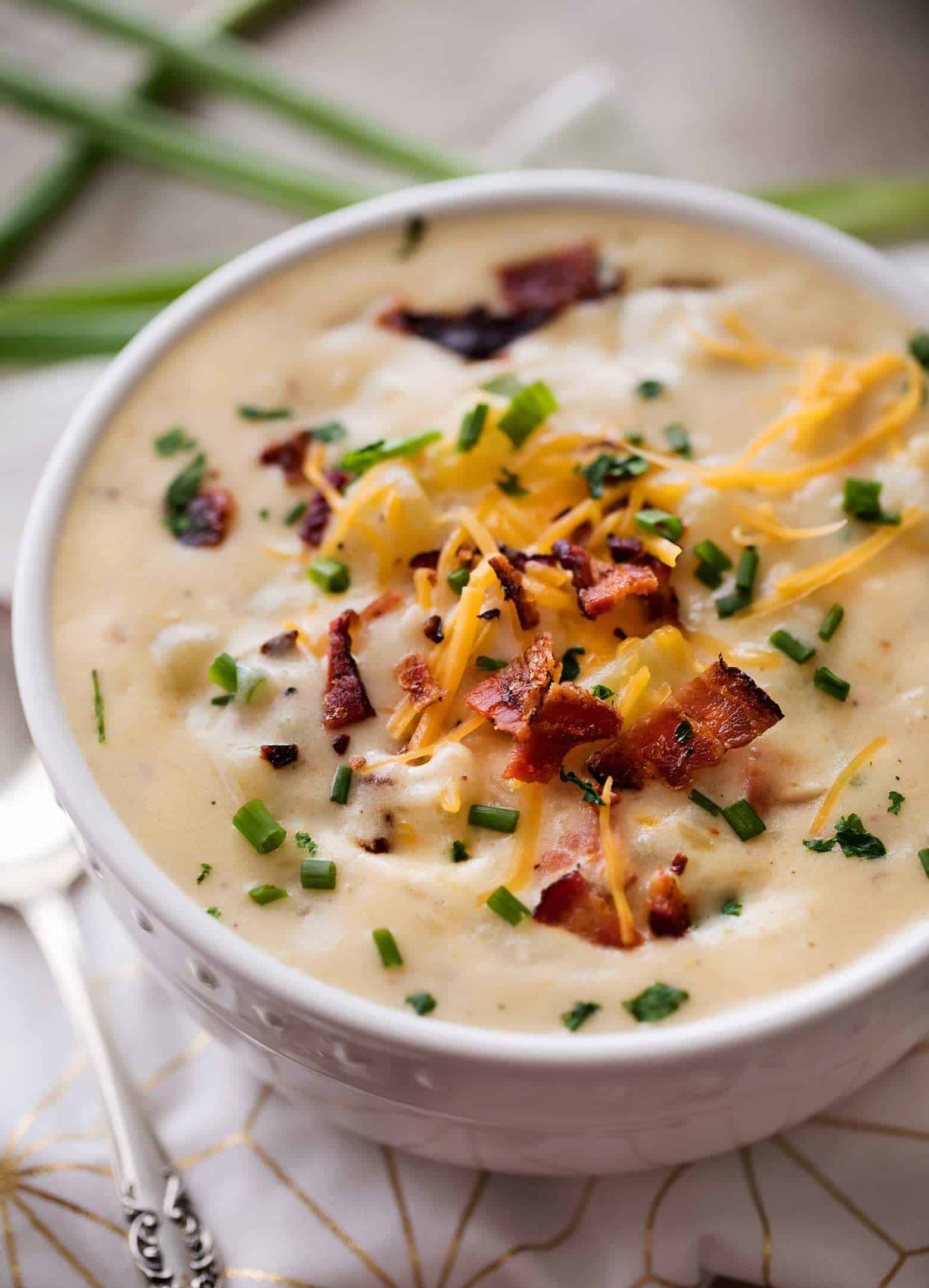
This might be the easiest dinner I've ever made. My husband was concerned that it was too thick, but I was more concerned that it would be bland. Well, it turned out that neither of us had anything to worry about. The mixture magically transformed into a wonderfully delicious bowl of soup. We both loved it. We topped the soup with some bacon bits, cheese and sour cream. I would have added green onions, but I didn't have any. Next time!
- Carbohydrate 56.7535383974359 g
- Cholesterol 50.96 mg
- Fat 47.3550867948718 g
- Fiber 0.285214743589744 g
- Protein 17.5898528846154 g
- Saturated Fat 11.7313475641026 g
- Serving Size 1 1 Recipe (729g)
- Sodium 5737.11356410256 mg
- Sugar 56.4683236538462 g
- Trans Fat 8.73750679487179 g
- Calories 723 calories
Step-by-step
- In a crock-pot, combine everything except for the cream cheese.
- Cook for 8-10 hours on low.
- About 15 minutes before serving, add cream cheese.
- Stir until melted and thoroughly combined.
- Serve with cheese, sour cream, bacon bits, green onions.
Stiff budget constraints demand ingredients that yield maximum volume without inflating grocery costs, making frozen shredded potatoes an economical base for large-batch soups. Standardizing this recipe for a crowd requires multiplying the frozen hash browns, chicken broth, and canned soup proportionally while holding the dried onion flakes slightly below a direct multiple to prevent bitterness. Scaling down demands careful observation of liquid reduction rates, since smaller volumes evaporate faster across the perimeter of ceramic slow cooker inserts. High-capacity slow cookers rated at six quarts or larger maintain optimal heat distribution when filled between the halfway and two-thirds marks.
Temperature control dictates the successful integration of dairy products added late in the cooking cycle. Adding blocks of cream cheese directly to boiling or high-heat environments causes milk solids to break and separate into a grainy emulsion. Incorporating the cream cheese during the final fifteen minutes of the low-heat cycle allows the residual thermal energy to soften the dairy without scorching the bottom of the pot. Whisking the mixture vigorously immediately after the cheese softens ensures a uniform, velvety body throughout the broth.
Starch management separates amateur preparations from professional results when utilizing processed potato products. Pre-shredded frozen potatoes contain surface starches and protective coatings that thicken liquids efficiently without requiring an explicit flour-based roux. Allowing the soup to rest uncovered for ten minutes off the heat allows excess moisture to release into the air, tightening the consistency further before service. Adjusting the final seasoning with kosher salt must occur only after the soup has thickened completely, because water reduction concentrates dissolved minerals significantly.
Prepared portions retain optimal quality in airtight containers stored at or below 40 degrees Fahrenheit for up to four days. Reheating leftover soup requires gentle stovetop application over medium-low heat alongside a splash of additional chicken broth to compensate for moisture lost during refrigeration. Freezing is generally discouraged because high-fat dairy emulsions and reconstituted potato cells tend to separate into an undesirable watery texture upon thawing.



