Chicken Caldereta
A Filipino traditional dish, with a little twist. Normally this dish is made with beef, pork or lamb but I prefer chicken. What I was told about this dish is that it takes the western flavors and adds it to the common flavors of the Philippines. I hope you enjoy!
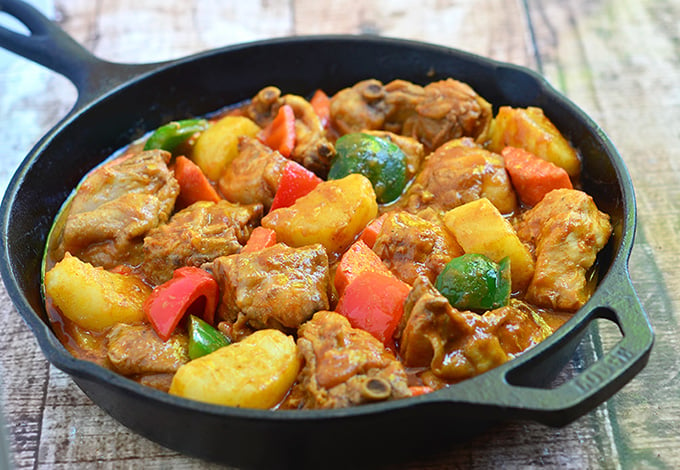
A Filipino traditional dish, with a little twist. Normally this dish is made with beef, pork or lamb but I prefer chicken. What I was told about this dish is that it takes the western flavors and adds it to the common flavors of the Philippines. I hope you enjoy!
- 1 tsp. salt
- 3 cloves garlic
- 2 carrots
- 1 tsp. black pepper
- 1 can tomato paste
- 2.5 chicken breast
- 3 soy sauce
- 1 vinegar
- 3 oil
- 2 white wine
- 1 tsp. dried chili peppers
- 4 ketchup
- 1 small onions
- 3 small potatoes
- 1 cup green peas
- 2 tsp lime
- 0.5 green pepper
- 1 medium tomato medium
- 1 small ginger piece
- 1 tsp sugar (optional)
- Carbohydrate 55.5201229160205 g
- Cholesterol 162.4 mg
- Fat 14.8476719791129 g
- Fiber 9.9709115014203 g
- Protein 74.0789158332355 g
- Saturated Fat 1.79279473957581 g
- Serving Size 1 1 Serving (700g)
- Sodium 1069.23376041582 mg
- Sugar 45.5492114146002 g
- Trans Fat 1.63028822915325 g
- Calories 656 calories
Step-by-step
- Put the chicken in a bowl, together with soy sauce, black pepper, and vinegar.
- Marinate it for 30 minutes to get the flavor.
- Prepare the frying pan in a low heat.
- Add the oil, when the oil is hot enough.
- Add the onions and let it cook for 2 minutes.
- Then put the tomatoes next
- Stir it and cook for another 2 minutes.
- After 2 minutes add the chicken, and the soy sauce.
- Mix it well with the tomatoes and onions.
- Simmer it for 30 minutes.
- Add wine, tomato paste, ketchup, salt, seasoning, lime, and potatoes.
- Simmer it for another 10 minutes.
- Stir it from time to time though.
- Then add carrots, green peas,sugar and the green pepper.
- Simmer it for 20 minutes.
Standard ingredient lists provide quantities without explaining how components behave under heat. Replacing red meat with poultry significantly alters cooking times and fat rendering properties. Chicken breasts contain considerably less intramuscular fat than beef chuck or goat shoulder, requiring careful attention during the initial simmer to prevent the protein from drying out.
The Role of Acidity and Marinades
Soaking poultry in a mixture containing vinegar and soy sauce for 30 minutes initiates protein denaturation before the meat hits the pan. Acid breaks down surface fibers, allowing secondary flavor compounds from garlic and ginger to penetrate deeper into the tissue. Maintaining low heat during the initial onion and tomato reduction prevents scorching while caramelizing natural sugars.
Staggered Vegetable Additions
Adding root vegetables at different stages ensures uniform texture throughout the finished stew. Potatoes require a longer simmering window to soften completely in the acidic tomato and wine reduction, whereas green peas and bell peppers lose their vibrant chlorophyll and crisp bite if introduced too early. Incorporating delicate vegetables during the final twenty minutes preserves their structural integrity against prolonged thermal degradation.



