Chicken Parmesan
This is barely a recipe, but I thought I would give you a basic idea of how we put this together. It's one of my family's favorites.
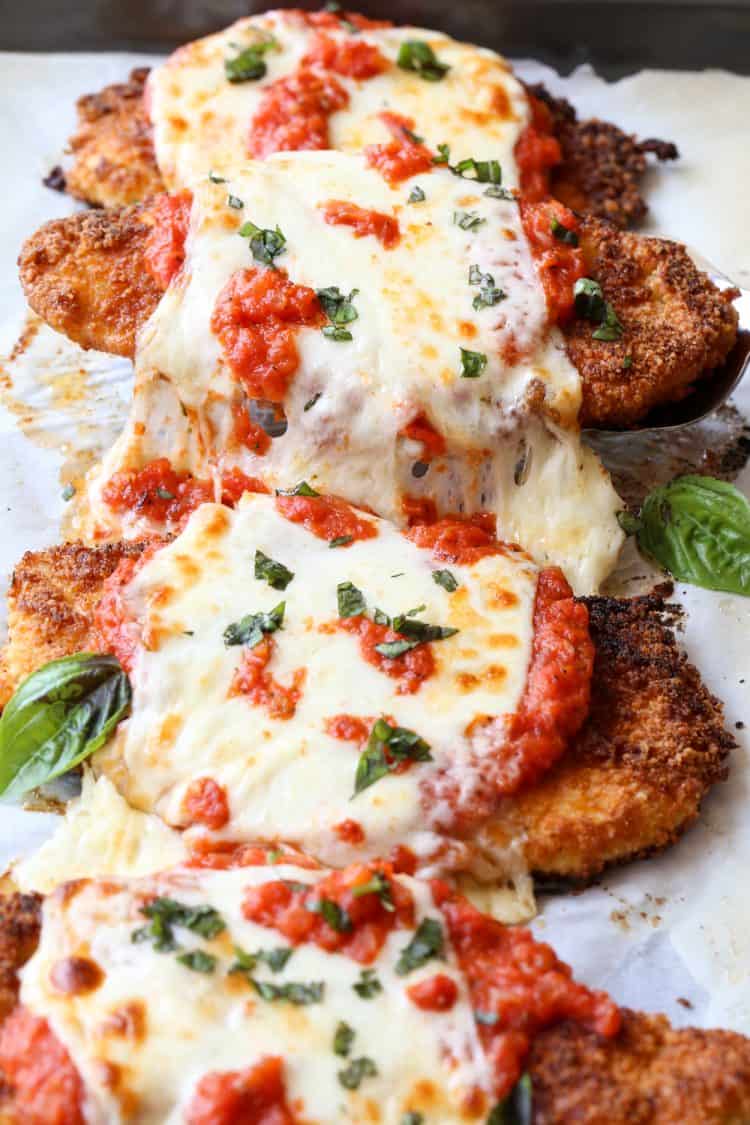
This is barely a recipe, but I thought I would give you a basic idea of how we put this together. It's one of my family's favorites.
- Carbohydrate 102.281750324293 g
- Cholesterol 337.431550007008 mg
- Fat 21.0022956988777 g
- Fiber 8.50527238206928 g
- Protein 70.9291809937469 g
- Saturated Fat 7.88935084114605 g
- Serving Size 1 1 Serving (547g)
- Sodium 1448.39352144136 mg
- Sugar 93.7764779422233 g
- Trans Fat 2.77256527707367 g
- Calories 902 calories
Step-by-step
- Place the flour on a plate. Place the eggs in a shallow bowl and beat to combine. Combine the parmesan cheese and breadcrumbs on another plate.
- Season the chicken breasts with salt and pepper. Coat lightly with the flour, shaking off the excess. Dip in the egg mixture and then into the parmesan mixture, pressing to adhere the crust. Set on a clean plate. Repeat with all the chicken breasts.
- Preheat the oven to 350 degrees. Brown the chicken in a bit of oil over medium high heat in an oven-proof skillet; it will not be cooked all the way through. Pour the marinara sauce around and under the chicken and place in the oven. Cook for 20 minutes.
- Top each chicken breast with one slice of cheese and return to the oven to cook until the cheese melts, about 3 minutes.
- Serve the chicken over spaghetti noodles with the sauce and pass additional parmesan cheese.
The ingredient list alone cannot explain how moisture interacts with a breadcrumb crust during high-heat cooking. Boneless, skinless chicken breasts release water when subjected to heat, which can instantly turn a crisp coating into a soggy layer if the pan temperature drops. Dredging the meat requires a dry surface, so patting the chicken completely dry with paper towels before flouring ensures the protein bonds properly with the starch. Shaking off excess flour prevents clumps from forming a barrier that blocks the egg wash from gripping the surface.
Structuring the cooking process efficiently means browning the meat on the stovetop before transferring the skillet to an oven preheated to 350 degrees. Searing chicken over medium-high heat creates Maillard reactions in the parmesan and breadcrumb matrix, producing savory depth that simple baking cannot replicate. Because the center remains partially raw after the quick sear, the subsequent twenty-minute oven phase finishes cooking the interior gently while simmering the surrounding marinara sauce. Timing the spaghetti to finish concurrently with the final three minutes of cheese melting prevents the pasta from sticking together.
Freezing this dish successfully depends entirely on the preparation stage chosen prior to thermal processing. Assembled cutlets that have been breaded but not yet cooked can be frozen raw on a sheet pan for two hours, then transferred to a sealed plastic bag for up to two months. When ready to cook, thaw the chicken overnight in the refrigerator before proceeding with the sear and bake steps, as baking frozen breaded poultry directly causes the crust to delaminate. Fully baked leftovers maintain quality for three days stored in an airtight container.
Reheating single portions requires careful management of thermal gradients to prevent the chicken from becoming rubbery. Microwaving ruins the structural integrity of the melted mozzarella and softens the crispy exterior, making a toaster oven or standard oven heated to 325 degrees the superior choice for restoring texture. Placing the cutlet on a wire rack inside a baking sheet allows air circulation underneath, crisping the bottom crust while the interior warms through in approximately fifteen minutes.



