Peach Plum Pie
When I want to impress guests, this is the pie I prepare. Peaches, plums and a bit of lemon peel are a refreshing trio that wakes up taste buds. It's a family favorite that's requested often.
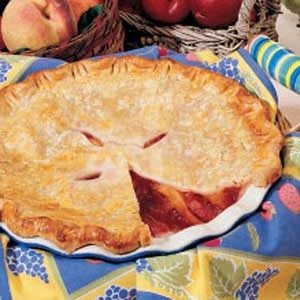
When I want to impress guests, this is the pie I prepare. Peaches, plums and a bit of lemon peel are a refreshing trio that wakes up taste buds. It's a family favorite that's requested often.
- 1/4 teaspoon salt
- 1 tablespoon lemon juice
- 1-1/2 cups sugar
- 2 tablespoons butter
- 1/4 teaspoon almond extract
- 2 cups fresh peaches chopped peeled, or frozen unsweetened, thawed and drained
- 2 cups fresh purple plums sliced peeled
- 1/4 cup quick-cooking tapioca
- 1/2 to 1 teaspoon grated lemon peel
- pastry for double-crust pie (9 inches)
- Carbohydrate 79.868289210521 g
- Cholesterol 61.006250026162 mg
- Fat 23.7973358432126 g
- Fiber 5.15891665428205 g
- Protein 3.18181750027534 g
- Saturated Fat 14.6372583395864 g
- Serving Size 1 1 Recipe (401g)
- Sodium 164.178083404112 mg
- Sugar 74.7093725562389 g
- Trans Fat 1.85569383402757 g
- Calories 529 calories
Step-by-step
- In a large bowl, combine the peaches, plums, lemon juice and extract. In another bowl, combine sugar, tapioca, lemon peel and salt. Add to fruit mixture and stir gently; let stand for 15 minutes. Line a 9-in. pie plate with bottom crust; add the filling. Dot with butter.
- Roll out remaining pastry to fit top o pie; cut slits in pastry. Place over filling. Trim, seal and flute edges. Cover the edges loosely with foil.
- Bake at 450° for 10 minutes. Reduce heat to 350°. Remove foil; bake 35 minutes longer or until crust is golden brown and filling is bubbly.
Can frozen fruit match the performance of fresh in a high-pectin pie? Frozen peaches require thorough draining to prevent excess liquid from breaking down the bottom crust. Fresh purple plums contribute natural tartness that balances the high sugar content, but yellow plums or even pluots substitute cleanly at a one-to-one volume. Let the macerated fruit rest for the full 15 minutes so the quick-cooking tapioca absorbs free moisture before baking.
Managing Starch and Sugar Ratios
Tapioca provides a glossy sheen and clear finish without the cloudy opacity of cornstarch. If replacing tapioca with all-purpose flour, increase the thickener amount by fifty percent to achieve identical set properties. White sugar dissolves rapidly into the fruit juices during the resting phase, creating a syrup that cooks evenly once inside the oven.Baking Dynamics and Heat Control
Starting the pie at 450 degrees for 10 minutes sets the pastry structure quickly before the butter melts entirely into the pan. Dropping the temperature to 350 degrees prevents the fruit sugars from burning while the interior bubbles vigorously. Remove the foil shield at the temperature drop to allow the fluted edges to achieve a deep golden brown. Scaling this formulation down to individual handheld pies requires shortening the initial high-heat phase to six minutes. Cool the baked pie completely on a wire rack before slicing to let the internal starches lock the structure in place.


