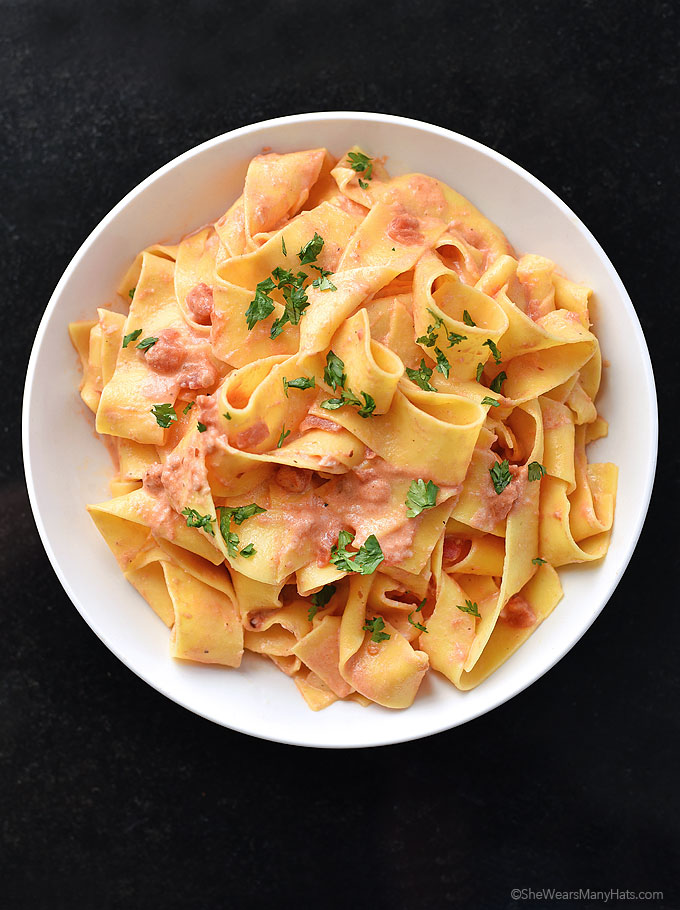
Easy, fairly cheap unless you put in a lot of vodka, and so much fun to cook and share.
- Carbohydrate 67.4546964530829 g
- Cholesterol 108.85 mg
- Fat 17.3070162385023 g
- Fiber 5.44370380596218 g
- Protein 15.5126593277717 g
- Saturated Fat 9.51762980942956 g
- Serving Size 1 1 Serving (570g)
- Sodium 502.77875627171 mg
- Sugar 62.0109926471208 g
- Trans Fat 1.57093616095912 g
- Calories 640 calories
Step-by-step
- In a large pot put on the rigatoni to boil.
- Meanwhile in a large skillet put the evoo, butter, garlic, and shallots and fry it up until the shallots are clear and happy.
- Add in the vodka and reduce by half.
- Add in the tomatoes and chicken broth and bring to a bubble.
- Add in the cream and bring it back up to a bubble.
- Throw in the basil and serve.
Standard marinara relies on a long, slow simmer to concentrate flavors, whereas vodka sauce operates on a completely different timeline that rewards rapid reduction and aggressive heat control. Understanding how to sequence the additions keeps the dairy from breaking when it hits the acidic tomato base. Cooking proceeds efficiently when multiple burners operate simultaneously.
The Chemical Role of Alcohol and Acid
Pouring the spirit directly onto the sautéed shallots and garlic requires careful attention to the flame to avoid flare-ups. Allowing the liquid to reduce by half is non-negotiable; failing to evaporate the harsh ethanol leaves a sharp, unpleasant burn that no amount of heavy cream can mask. Crushed tomatoes introduce high levels of malic and citric acid, which chemically alter the milk proteins in the cream, meaning the dairy must be added last and brought only briefly back to a bubble rather than boiled vigorously for hours.
Managing Pan Dynamics and Pasta Water
Rigatoni holds up well to heavy sauces because its wide bore traps thick pools of liquid while the ridged exterior grips the emulsion. Starchy water reserved from the boiling pot adjusts viscosity if the sauce thickens too rapidly during the final toss. Doubling or tripling the batch requires switching to a wide Dutch oven rather than a standard skillet to ensure adequate surface area for proper evaporation. Tossing the pasta directly in the skillet for sixty seconds bonds the starches to the fats for a cohesive coating.



