Sweet Potato Casserole
I have had many sweet potato casseroles; however, this was brought to our company Thanksgiving lunch and it was the best that I have ever had.
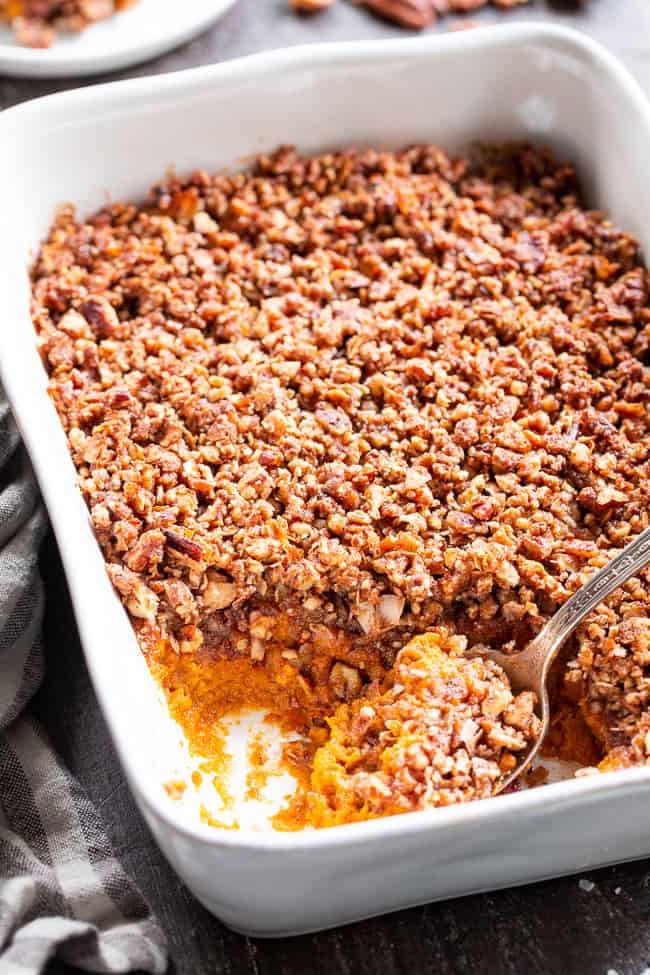
I have had many sweet potato casseroles; however, this was brought to our company Thanksgiving lunch and it was the best that I have ever had.
- Carbohydrate 128.681654859567 g
- Cholesterol 109.489305616015 mg
- Fat 32.4659192004986 g
- Fiber 3.10359729341272 g
- Protein 4.63520611261731 g
- Saturated Fat 12.9235712653895 g
- Serving Size 1 1 Serving (229g)
- Sodium 202.922944645605 mg
- Sugar 125.578057566154 g
- Trans Fat 2.12190325210526 g
- Calories 799 calories
Step-by-step
- Boil potatoes until done, peel and mash well with mixerr. Melt butter, add to potatoes, add sugar and salt. Beat eggs and add vanilla and flour. Add everything together and mix thoroughly. Pour mixture into a greased pyrex dish.
- Topping - Mix topping ingredients and spread over potatoes. Bake at 350 degrees for 35 minutes or until golden brown.
The Chemistry of Second-Day Setting
Starches in cooked sweet potatoes undergo retrogradation as the casserole cools, meaning the amylose and amylopectin molecules recrystallize and create a firmer internal structure. This chemical realignment actually improves sliceability after twenty-four hours in the refrigerator. Reheat portions at 325 degrees Fahrenheit for fifteen minutes to restore the interior moisture without burning the pecan crust.
Managing Moisture in the Mash
Boiling whole tubers with their skins intact prevents waterlogging during the mashing phase. When pureeing the cooked sweet potatoes, incorporate the melted butter before adding the eggs to temper the dairy and prevent curdling. Mixing flour directly into the beaten eggs prior to combination acts as a stabilizing binder, ensuring the casserole holds its shape when portioned.
Proportional Scaling and Yield Adjustments
Multiplying this formulation for larger gatherings requires careful attention to the baking vessel surface area rather than just doubling ingredient weights. A standard 9x13-inch glass dish maintains the optimal two-inch depth for even heat penetration at 350 degrees Fahrenheit. Deeper containers trap steam, prolonging the bake time and risking a soggy pecan topping.



