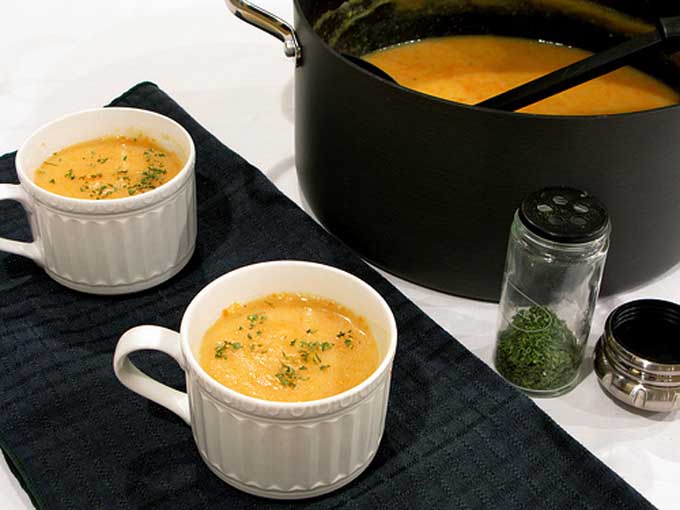
Try this French Potato Soup (Potage Parmentier) recipe.
- Carbohydrate 146.913910018665 g
- Cholesterol 203.5275 mg
- Fat 70.1133850009389 g
- Fiber 24.8405002160098 g
- Protein 19.0506750031536 g
- Saturated Fat 43.3786600002822 g
- Serving Size 1 1 Serving (1393g)
- Sodium 520.771500012672 mg
- Sugar 122.073409802655 g
- Trans Fat 4.75583500004034 g
- Calories 1242 calories
Step-by-step
- In a large sauce pan, add the water and all of the vegetables except the chives.
- Cover and cook over low heat for about two hours.
- Then add the salt and pepper.
- Drain the vegetables and KEEP the liquid!
- Process the vegetables in either a food mill or a blender.
- Return them to the liquid.
- Add the butter and the cream.
- Reheat and taste...you may wish to add a bit more salt...
- Serve sprinkled with the chives.
- To change that masterpiece into a Watercress Soup (Potage au Cresson), hold the chives.
- Instead finely chop a bunch of watercress and add it at the same time that you add the butter and cream.
- Serve with the top sprinkled with additional finely chopped watercress.
Potage Parmentier relies entirely on the starchy nature of waxy-to-medium potatoes like Kennebecs to achieve its traditional emulsion without requiring added flour or cornstarch. When scaling this classic French soup up or down, operators must recognize that liquid evaporation rates do not scale linearly in broad pots, meaning the initial cooking water volume requires careful monitoring during the two-hour simmer to prevent scorching. Selecting heavy-bottomed cookware ensures that the extended heat exposure breaks down the cell walls of the leeks and onions evenly into a tender purée.
Passing the cooked roots through a mechanical food mill rather than a high-speed blender yields a superior texture by shearing fibers cleanly instead of releasing excess free starch that can turn the soup gluey. Once the purée returns to the reserved cooking liquid, incorporating butter and heavy cream introduces milk solids that demand gentle reheating just below a simmer; boiling the mixture post-dairy risks breaking the emulsion and separating the fats. Adjusting the salt should always occur strictly after the dairy additions, as cream mutes sodium perception on the palate.
Storing leftover portions requires refrigeration within two hours in an airtight glass container, where the soup will keep safely for up to three days. Reheating chilled portions demands low heat on the stovetop accompanied by a gradual splash of water or milk to restore the original pouring consistency, since the starches continue to bind remaining moisture as the soup rests overnight.



