Old Fashioned Caramel Corn
To get a thicker coat of caramel, just use a little less popcorn. I used butter in this recipe since it wasn’t really for Elena and I, but coconut oil would work here too for a dairy-free version. You could also experiment with different sweeteners, such as maple sugar or coconut sugar.
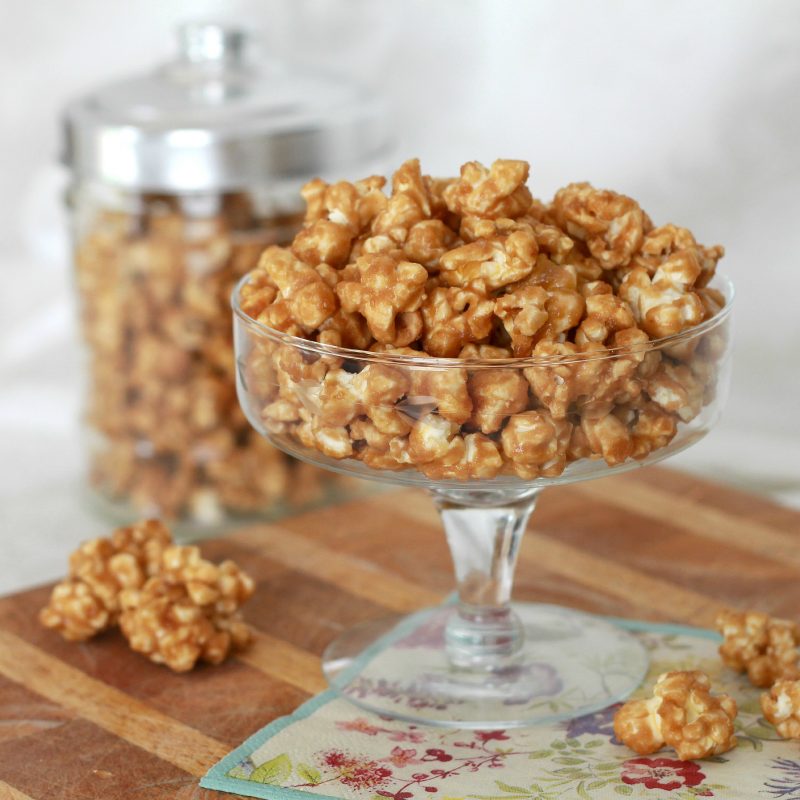
To get a thicker coat of caramel, just use a little less popcorn. I used butter in this recipe since it wasn’t really for Elena and I, but coconut oil would work here too for a dairy-free version. You could also experiment with different sweeteners, such as maple sugar or coconut sugar.
- Carbohydrate 10.4486508064516 g
- Cholesterol 15.2515625 mg
- Fat 6.23083231854839 g
- Fiber 1.52779687507893 g
- Protein 1.42733388104839 g
- Saturated Fat 3.70383278225806 g
- Serving Size 1 1 Serving (28g)
- Sodium 1929.70469153226 mg
- Sugar 8.92085393137268 g
- Trans Fat 0.504868141129033 g
- Calories 101 calories
Step-by-step
- Melt the butter, rapadura and honey together in a small pot. Allow to simmer for five minutes. Be very careful with this hot mixture, as it can cause bad burns.
- Meanwhile, place the popcorn in a large bowl with plenty of room to stir. When the mixture has simmer for the allotted five minutes, then add the baking soda and the vanilla and stir it in (it will get foamy).
- Take off of the heat and pour over the popcorn. Stir until well coated.
- Place on two jellyroll pans in a single layer and place in a 250 oven for about 45 minutes to an hour. This hardens the caramel. If a lot of the caramel is dripping onto the pan, you can give it a gentle stir back onto the popcorn throughout the cooking process.
- When done, remove from pans, breaking into small pieces and cool. Enjoy!
Replacing traditional white sugar with unrefined cane sugar introduces complex molasses notes that darken the syrup much faster during the five-minute simmer. Granulated sweeteners with higher mineral content burn at lower thresholds, requiring strict temperature vigilance over the heat source. Butter contributes water alongside milk solids, whereas using coconut oil removes that moisture entirely while altering the final fat crystallization. Adjusting the ratio by reducing the volume of popped kernels ensures a thicker coating per piece because the surface area decreases relative to the available sugar. Honey functions as an invert sugar here, preventing the sucrose molecules from forming large, gritty crystals as the mixture cools.
Simmering the butter, honey, and rapadura drives off excess water to concentrate the sugar syrup past the soft-ball stage. Achieving this density is necessary so the coating hardens rather than remaining sticky at room temperature. Chemical leavening reacts vigorously when introduced to hot sugar syrups. Baking soda decomposes upon contact with heat and acid, releasing carbon dioxide micro-bubbles that aerate the dense liquid. Whipping this gas into the syrup lightens the specific gravity of the coating, transforming a heavy glaze into a porous foam that coats the corn evenly without pooling at the bottom of the bowl.
Spreading the coated kernels across two jellyroll pans in a single layer maximizes exposure to dry oven heat. Baking at 250 degrees Fahrenheit for forty-five minutes to an hour drives off residual moisture from the starch and sets the caramel structure. Water acts as a plasticizer in sugar cookery, keeping confections pliable, so removing every trace of moisture locks in crispness. Stirring the mixture periodically redistributes any pooling syrup back onto the kernels before it solidifies permanently on the metal baking sheet. Monitoring the oven closely prevents scorching, since the honey and unrefined sugars darken rapidly during the final stages of dehydration.
Cooling the baked popcorn completely before breaking the mass into smaller pieces allows the sugar glass to stabilize without absorbing ambient humidity. Storing the finished snack in an airtight container prevents moisture from softening the brittle caramel matrix. Substituting liquid sweeteners or fats changes the moisture retention properties during this storage window, making precise baking times essential for achieving long-term crunch. Proper cooling guarantees that the microscopic air pockets created by the baking soda remain rigid, yielding a shatteringly crisp bite rather than a chewy texture.



