Caramelized Onion and Cornbread Stuffing
I saw this recipe on Food Network, tried it and loved it. I now have to cook two different kinds of dressings for Thanksgiving and Christmas. This recipe has become my favorite, but some of the family still enjoys our traditional stuffing.
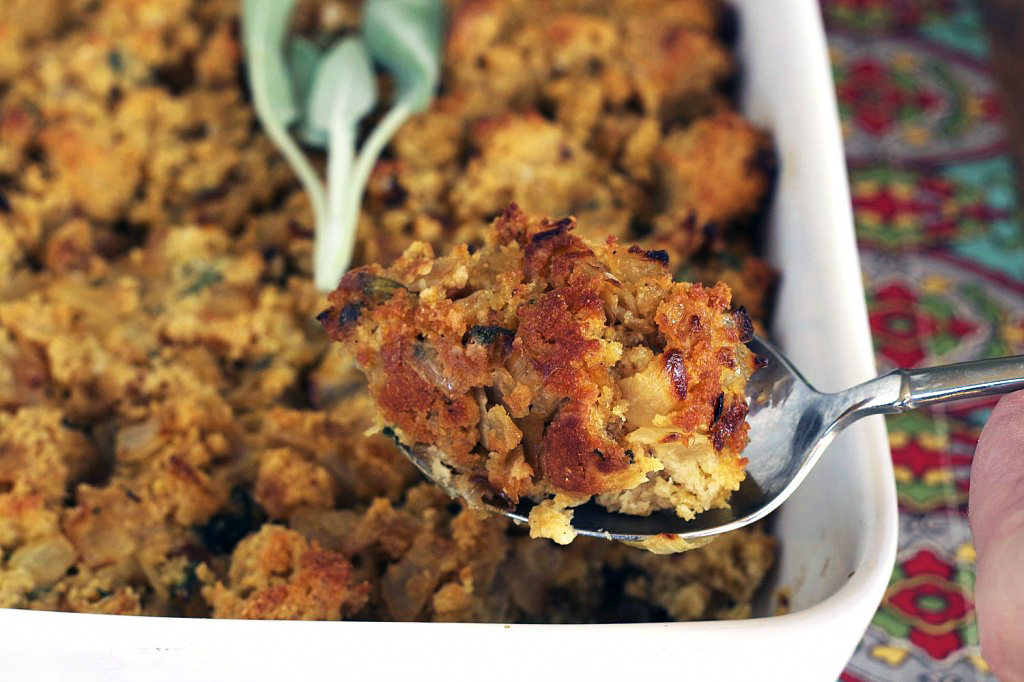
I saw this recipe on Food Network, tried it and loved it. I now have to cook two different kinds of dressings for Thanksgiving and Christmas. This recipe has become my favorite, but some of the family still enjoys our traditional stuffing.
- Carbohydrate 7.7529750007743 g
- Cholesterol 48.580625013523 mg
- Fat 6.71267708751879 g
- Fiber 1.24666670163473 g
- Protein 2.37504375057281 g
- Saturated Fat 3.89354166921784 g
- Serving Size 1 1 Serving (110g)
- Sodium 70.9241667049261 mg
- Sugar 6.50630829913958 g
- Trans Fat 0.522707083583234 g
- Calories 98 calories
Step-by-step
- Preheat the oven to 375 degrees F.
- Melt the butter in a medium skillet over medium heat.
- Add the onions and cook, stirring, for about 10 minutes, or until soft and caramelized.
- Add sage and scrape into a large mixing bowl.
- Add the cornbread pieces, season well with salt and pepper, and give it a good toss until it's well combined.
- In a seperate bowl, whisk together the egg, cream and stock, and pour that over the cornbread.
- Stir the stuffing together and stuff the cavity of the turkey.
- You could also spoon it it into a buttered baking dish and put it in the oven along with the turkey.
- Bake until hot and crusty on top, about 30 minutes.
The ingredient list leaves out the patience required at the stovetop, where raw alliums must transform through slow dehydration and enzymatic browning into deeply sweet brown fragments. Melting two tablespoons of butter in a medium skillet over medium heat starts this progression, but maintaining consistent contact between the sliced layers and the hot metal surface is what prevents scorching while sugars develop over ten minutes. When cooking large batches of alliums, a wide stainless steel or cast iron pan provides the necessary surface area to promote rapid moisture evaporation instead of steaming the vegetables. Fresh sage leaves join the pan near the end of this browning process, releasing fat-soluble aromatic compounds into the remaining butter before everything transfers to the mixing bowl. Cubed cornmeal muffins absorb these aromatic fats differently than standard loaf bread, requiring a precise ratio of liquid binding agents to prevent a crumbly texture during baking. Whisking one egg, a quarter cup of heavy cream, and a quarter cup of chicken stock together creates an emulsion that coats each cube uniformly without turning the starches into a dense paste. Although the traditional method involves filling the cavity of a turkey, spooning the mixture into a buttered baking dish allows direct heat exposure across the top surface, guaranteeing a crusty exterior when baked at 375 degrees Fahrenheit for thirty minutes. Utilizing a shallow casserole dish maximizes the surface-to-volume ratio, yielding significantly more crisp edges than a deep baking vessel ever could.



