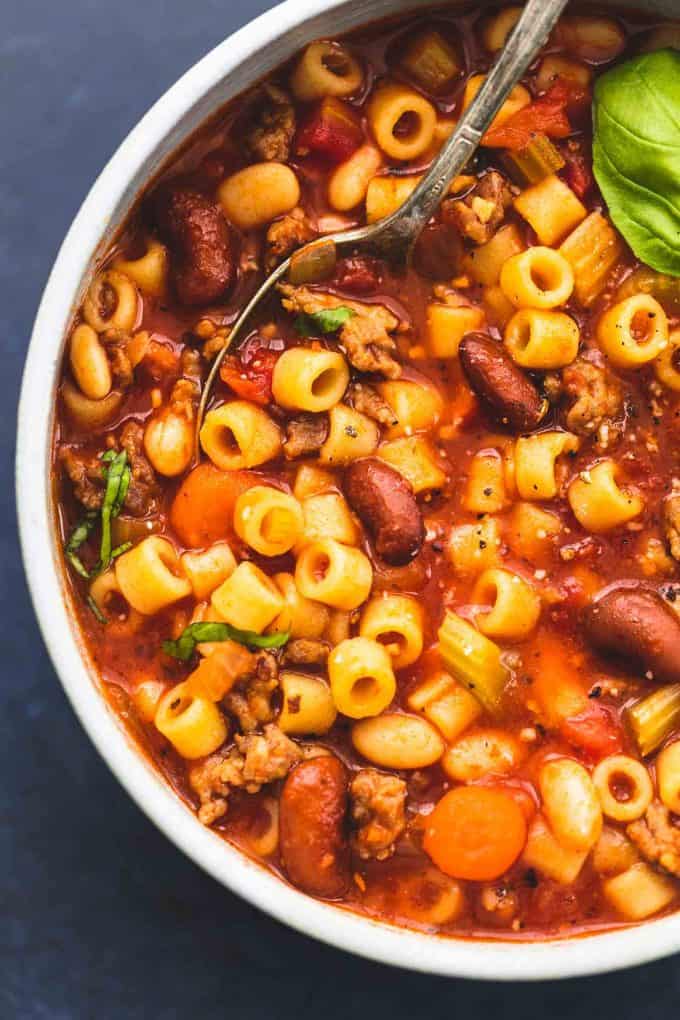
Italian soup – like grown-up hamburger helper
- 1 cup water
- 1 tablespoon olive oil
- 1 pound hot turkey italian sausage
- 1.5 tablespoons garlic minced
- 14 oz fat-free low-sodium chicken broth
- 8 oz no-salt tomato sauce
- 8 oz pasta uncooked (i use bowties)
- .5 cup shredded romano cheese
- 1.5 teaspoons dried oregano
- .25 teaspoon salt
- .25 teaspoon white pepper
- 2 cans (15.5 oz) white beans (cannellini, great northern, etc.) drained
- (optional) fresh parsley minced
- Carbohydrate 24.9129921329351 g
- Cholesterol 66.8266666666667 mg
- Fat 8.10605150761655 g
- Fiber 0.847151033203516 g
- Protein 15.9882687137423 g
- Saturated Fat 0.209532456745606 g
- Serving Size 1 1 Serving (239g)
- Sodium 974.201286027876 mg
- Sugar 24.0658410997316 g
- Trans Fat 6.95191049433572 g
- Calories 237 calories
Step-by-step
- Heat oil in a large saucepan, med-high heat.
- Add: sausage, garlic. Saute, stirring to crumble (2 min or until browned).
- Add: water, broth, tomato sauce. Bring to boil.
- Add: pasta, 1/4 c. cheese, oregano, salt, white pepper, beans. Bring to boil.
- Cover. Reduce heat. Simmer (8 min or until pasta is done).
- Let stand (5 min). Serve sprinkled with cheese. Garnish with parsley (optional).
Will the pasta turn to mush in the pot before the broth even reaches a simmer? Managing starch absorption during a rapid boil requires anticipating how dry grains behave when introduced to boiling liquids containing both water and acidic tomato solids. Starch molecules swell rapidly at 212 degrees Fahrenheit, but the presence of tomato acid delays gelatinization slightly, meaning timing the simultaneous hydration of pasta and warming of beans demands precise observation. When building soups containing dried pasta for future meals, professional kitchens deliberately undercook the noodles by two minutes because residual heat during storage will continue softening the starch.
Freezing this soup successfully relies entirely on how the liquid cools down prior to placement in airtight containers, which should happen within two hours to prevent bacterial growth. Portion the cooled mixture into rigid plastic containers leaving one inch of headspace for expansion, sealing them tightly to prevent freezer burn for up to three months. Reheating frozen portions requires gentle thawing overnight in the refrigerator followed by low heat on the stovetop, adding a splash of chicken broth if the starch has absorbed too much liquid during the resting phase.
Common errors involve boiling the dairy too aggressively or adding grated cheese directly into a rolling boil, which causes the proteins to curdle rather than melt into a smooth emulsion. Incorporating the romano cheese off the heat source ensures a velvety consistency without greasiness.



