Blueberry Cream Cheese Coffeecake
When we went to Disney back in 2004, we had something like this at our hotel restaurant, and Tim thought it was so good. When we got home, I made my own version of it for him for Fathers Day. Now I make it for him every Fathers Day.
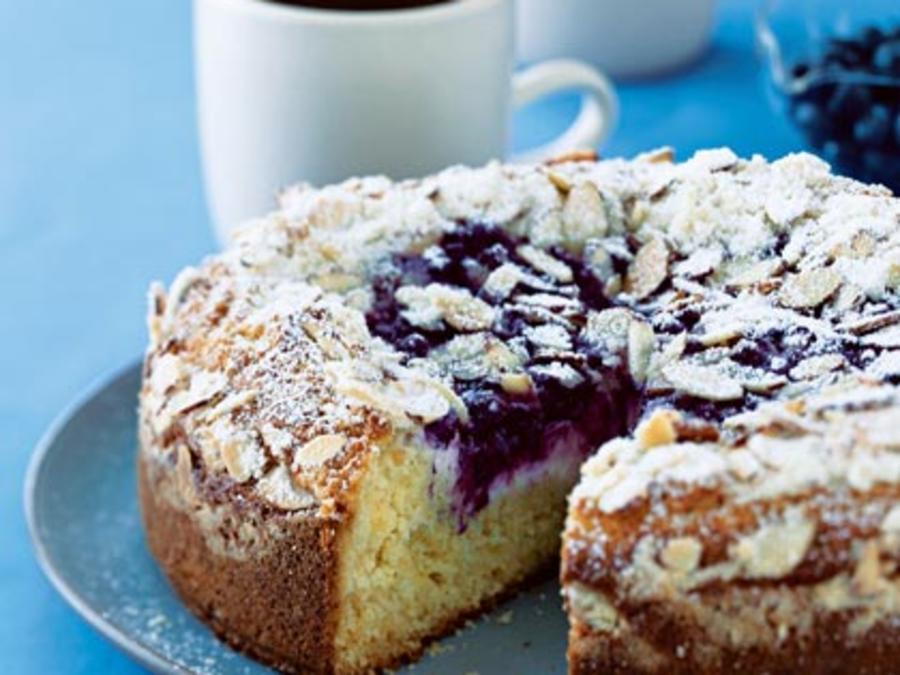
When we went to Disney back in 2004, we had something like this at our hotel restaurant, and Tim thought it was so good. When we got home, I made my own version of it for him for Fathers Day. Now I make it for him every Fathers Day.
- 1 teaspoon salt
- 1/4 cup water
- 1/4 cup sugar
- 1/2 cup butter
- 1/2 teaspoon cinnamon
- 1 teaspoon baking powder
- 2 tablespoons butter
- 2 large eggs
- 1/4 cup brown sugar
- topping
- 1/4 cup flour
- 1 1/4 cups sugar
- 3/4 cups milk
- 2 1/4 cups flour divided
- 3 cups blueberries (fresh or frozen)
- 8 ounces cream cheese cubed
- Carbohydrate 59.5062472594378 g
- Cholesterol 118.208921136026 mg
- Fat 18.6346788589698 g
- Fiber 1.80288615982039 g
- Protein 7.3249656609618 g
- Saturated Fat 10.5747437545828 g
- Serving Size 1 1 Serving (174g)
- Sodium 701.137658983464 mg
- Sugar 57.7033610996174 g
- Trans Fat 2.07274390900381 g
- Calories 425 calories
Step-by-step
- Preheat oven to 375?
- Mix the sugar and butter until fluffy. Add the eggs, one at a time and mix well.
- In another bowl, combine 2 CUPS of flour, baking powder, and salt. Add to the creamed mixture, alternately with the milk and water. Fold in the sour cream and cream cheese chunks. In another bowl, toss the blueberries in the remaining 1/4 cups of flour, and gently fold into the batter. Pour into a 9" x 13" pan sprayed with nonstick spray.
- Combine the topping ingredients until it resembles coarse crumbs. Sprinkle over the batter. Bake at 375? for 50-60 minutes.
Golden crumbs contrast sharply against a tender, dense crumb punctuated by pockets of jammy, collapsed fruit and pockets of rich, softened dairy. Achieving this texture relies entirely on mechanical leavening through proper fat aeration. Creaming the butter and sugar forces microscopic air cells into the fat matrix, which expand later under heat to create a light cake rather than a dense pound cake. Adding eggs one at a time ensures total emulsification, preventing the fat from breaking and separating into a greasy mess.
Moisture management defines the success of adding fruit to a thick batter, especially when choosing between fresh and frozen berries. Fresh berries offer structural integrity and release minimal liquid during the initial stages of baking, whereas frozen berries introduce excess water content that can sink to the bottom or create soggy pockets. Tossing either type in a quarter cup of flour before folding coats the exterior, creating a friction layer that slows down the descent of the fruit through the batter during the fifty to sixty minute bake at 375 degrees.
Cream cheese introduces distinct physical behaviors compared to standard baking fats because its moisture and solid milk proteins do not blend uniformly into the crumb. Cubing the cream cheese and folding those pieces in raw ensures they retain distinct pockets throughout the slice rather than dissolving entirely into the flour mixture. As the cake bakes, these pockets soften into creamy ribbons that balance the tart sweetness of the fruit.
Testing for doneness without a thermometer requires observing physical indicators around the edges and center of the pan. The crust should pull slightly away from the interior walls of a nine by thirteen inch baking dish, and a wooden toothpick inserted into the thickest part near the center must emerge completely clean without wet batter clinging to it. Allowing the structure to cool partially solidifies the interior fats, making precise slicing achievable without tearing the crumb.



