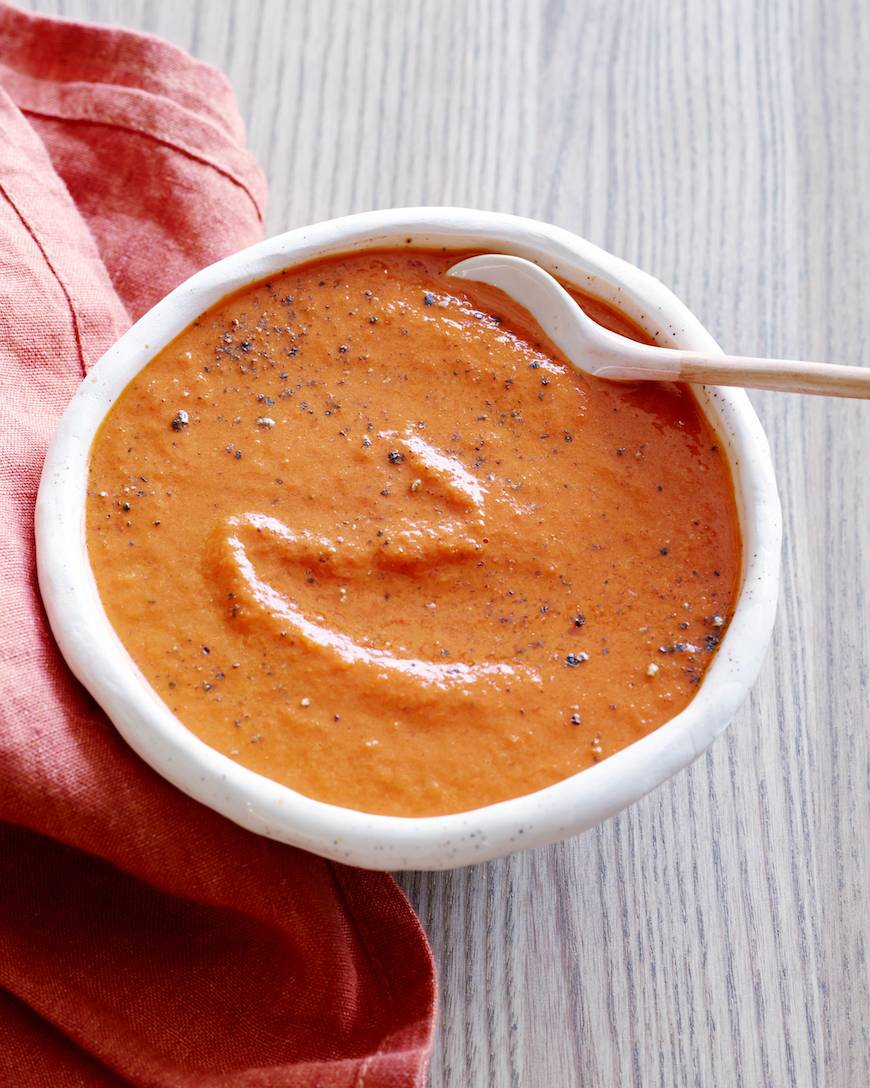
Use as a dip or with fish, meat, or pasta.
- Carbohydrate 0.254835 g
- Cholesterol 0 mg
- Fat 0.077715 g
- Fiber 0.122400003433228 g
- Protein 0.054045 g
- Saturated Fat 0.01467 g
- Serving Size 1 1 Serving (0g)
- Sodium 0.135 mg
- Sugar 0.132434996566772 g
- Trans Fat 0.013005 g
- Calories 1 calories
Step-by-step
- Put everything in a blender and blend.
Can an ordinary countertop blender actually break down canned whole tomatoes and jarred peppers into a uniform emulsion without heating the mixture first? Achieving a smooth consistency relies entirely on vortex creation inside the jar container, which means filling the appliance no higher than two-thirds capacity to allow proper food circulation. When blades spin at high velocities, they shear fibrous tomato walls and pepper skins into microscopic particles, suspending solids evenly across the liquid phase. If the motor stalls or chunks stubbornly adhere to the upper walls of the pitcher, stopping the machine to scrape down the sides with a rubber spatula restores the necessary flow.
Processing raw canned tomatoes directly with oil-packed peppers introduces natural glutamates and acids that interact instantaneously upon mechanical disruption. Citric acid from the tomatoes brightens the sweet, caramelized notes of the fire-roasted peppers, while capsaicin from the crushed red pepper flakes binds to fat molecules from the oil to distribute heat evenly across the palate. This lipid suspension prevents the spice from pooling harshly on the tongue, creating a rounded warmth instead of a sharp prickle. Allowing the finished purée to rest for fifteen minutes at room temperature encourages these distinct compounds to equilibrate fully.
Standard immersion blenders present a viable alternative for small kitchens lacking a traditional jug blender, provided the operator utilizes a deep, narrow vessel like a four-cup liquid measuring cup to prevent excessive splashing. Submerging the blade guard completely before powering the motor minimizes air incorporation, which keeps the sauce dense rather than frothy. Working in short, three-second pulses prevents the motor from overheating while giving granular control over the final particle size of the red pepper skins. Thoroughly drying the jarred peppers on paper towels beforehand also prevents unwanted dilution, ensuring the sauce retains sufficient body to cling to pasta strands.
Storing the finished condiment requires a clean glass mason jar sealed tightly with a plastic lid to prevent the reactive tomato acids from corroding metal closures over time. Kept at a refrigeration temperature of thirty-eight degrees Fahrenheit, the sauce maintains optimal flavor integrity for up to five days before the raw tomato notes begin to flatten. Freezing remains an option for longer preservation, though the emulsion may separate slightly upon thawing due to water crystal formation breaking down the suspended tomato cellular walls. Whisking the defactored liquid vigorously over medium heat on the stovetop for three minutes easily reintegrates any separated fats before service.



