Slow Cooker Chicken Cacciatore
Very good! I used 8-9 pieces of chicken breast. I cooked on high for about ½ hour because some of the breasts were partially frozen, then on low for about 6 hours.
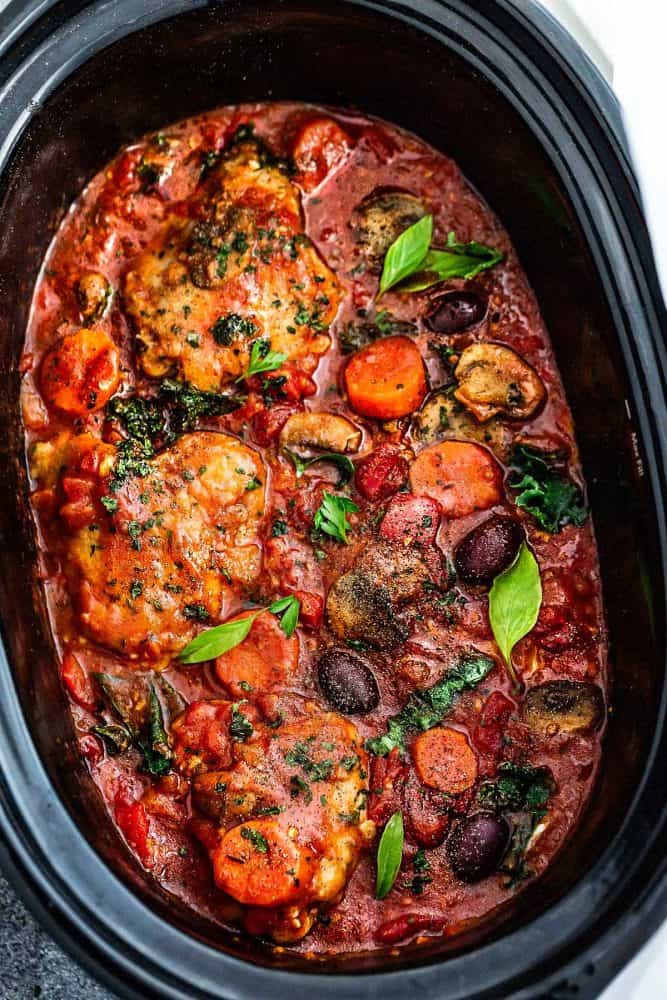
Very good! I used 8-9 pieces of chicken breast. I cooked on high for about ½ hour because some of the breasts were partially frozen, then on low for about 6 hours.
- Carbohydrate 10.3450270940171 g
- Cholesterol 65.77089365 mg
- Fat 1.4715641461453 g
- Fiber 0.568585785836873 g
- Protein 26.8201404556859 g
- Saturated Fat 0.390564590933761 g
- Serving Size 1 1 Serving (157g)
- Sodium 198.244354142094 mg
- Sugar 9.77644130818022 g
- Trans Fat 0.391224476617521 g
- Calories 171 calories
Step-by-step
- Put the onions and peppers at the bottom of the slow cooker.
- Add chicken.
- Top with mushrooms.
- Mix remaining ingredients and pour over top.
- Cook on Low 7 to 9 hours (High 4 to 5 hours).
- Serve over pasta or rice.
Red cooking wine anchors this dish by introducing essential tartaric and malic acids that break down tough muscle fibers in chicken breasts during long cooking cycles. Combining flour directly with the liquids creates a dispersed starch network that gelatinizes as temperatures approach the simmer point inside the ceramic vessel, thickening the surrounding tomato juices without scorching. Diced tomatoes supply pectin and natural glutamates, which concentrate as moisture evaporates over seven hours on low heat. Layering sliced onions and bell peppers beneath the poultry protects the meat from direct contact with the heating element while releasing moisture that steams the upper ingredients. When adapting the recipe, substituting white cooking wine alters the final color and yields a sharper, less complex acidity than red varieties. Storing leftovers in an airtight glass container within a refrigerator maintains food safety for up to four days. Reheating portions requires reaching an internal temperature of 165 degrees Fahrenheit to ensure proper pasteurization of the poultry.



