Peach Tartlets
Tarts are special treats that show off summer fruits so sweetly. The pastry is rich, tender and crunchy, almost like a cookie. I use it for every type of tart I can think of.
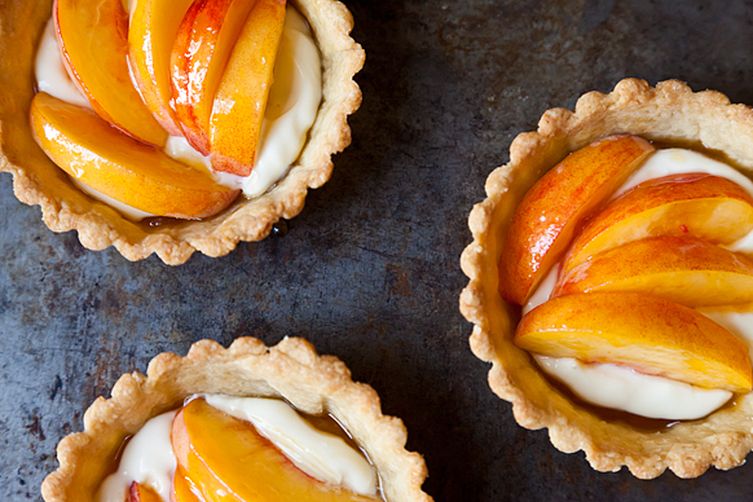
Tarts are special treats that show off summer fruits so sweetly. The pastry is rich, tender and crunchy, almost like a cookie. I use it for every type of tart I can think of.
- Carbohydrate 2.67483364626108 g
- Cholesterol 113.505000051617 mg
- Fat 24.2478258528064 g
- Fiber 0.739374973082514 g
- Protein 1.68131354187282 g
- Saturated Fat 15.0057603456658 g
- Serving Size 1 1 Serving (151g)
- Sodium 6456.54452880101 mg
- Sugar 1.93545867317856 g
- Trans Fat 1.6805753346965 g
- Calories 229 calories
Step-by-step
- In a large bowl, combine the flour, sugar and salt; cut in butter until mixture resembles coarse crumbs. Add water and egg yolks; stir until dough forms a ball.
- Divide into eight portions; press onto the bottom and up the sides of eight 4-in. tart pans. Bake at 400° for 15-20 minutes or until golden brown. Cool on wire racks.
- For filling, in a large saucepan, combine the sugar, cornstarch and salt. Stir in water until smooth. Bring to a boil; cook and stir for 2 minutes or until thickened. Remove from the heat. Stir in peaches and lemon juice.
- Spoon into tart shells. Chill until serving. Garnish with whipped cream if desired.
Scaling Proportions for Different Yields
Adjusting the batch size requires careful attention to the liquid ratios in both the crust and the filling. When halving the recipe, use a kitchen scale to weigh the egg yolks rather than guessing volumes. Flour absorption rates vary by brand, so add the cold water incrementally until the dough just holds together. Excess moisture transforms a flaky crust into a tough shell.
Protecting Crust Texture
Achieving a crumbly, cookie-like texture depends entirely on fat distribution and temperature. Cold butter must be cut into the flour until the pieces resemble coarse crumbs before adding liquids. If the butter melts during mixing, the released water vaporizes in the 400-degree oven, creating dense, gluten-developed layers instead of a tender bite.
Managing Starch Gelatinization
The stovetop filling relies on precise heating for proper setting. Cornstarch requires boiling temperatures to fully gelatinize and remove raw starch flavors. Stir continuously for the full two minutes after the mixture reaches a boil. Incomplete cooking leaves the peach glaze cloudy and structurally weak.



