Kefir Cottage-Style Cheese
From Dom's Kefir Cheese Making website: "There are other types of cheese that I prepared with kefir. Explained here is a fresh, sweet curd cheese, similar to cottage cheese or pannier of India. Kefir-cottage-cheese is quick and easy to prepare. Note that this is a rennet-free cheese like the majority of cheeses I prepare."
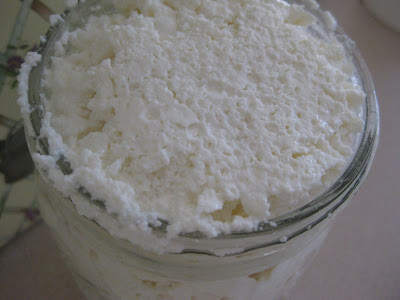
From Dom's Kefir Cheese Making website: "There are other types of cheese that I prepared with kefir. Explained here is a fresh, sweet curd cheese, similar to cottage cheese or pannier of India. Kefir-cottage-cheese is quick and easy to prepare. Note that this is a rennet-free cheese like the majority of cheeses I prepare."
- Carbohydrate 0 g
- Cholesterol 0 mg
- Fat 0 g
- Fiber 0 g
- Protein 0 g
- Saturated Fat 0 g
- Serving Size 1 1 Serving (0g)
- Sodium 0 mg
- Sugar 0 g
- Trans Fat 0 g
- Calories 0 calories
Step-by-step
- Heat milk to about 60°C [140°F].
- While gently stirring the milk, slowly pour kefir into the milk as a slow steady stream. Do not stir too fast or too vigorously or for too long or the curds will break apart and become un-retrievable. The curds should begin separating from the whey-- the whey should be reasonably clear and not milky. If the whey is still milky, either increase the heat, or add a little extra kefir [while very gently stirring for a short time only] until the whey becomes reasonably clear. Let sit for 2 minutes.
- Remove curds by skimming with a strainer.
- Place curds in either a pre-moistened cheesecloth lined colander, or in a suitable mesh-type strainer.
- Let curds drain for about 15 minutes. Presto... that's it!
Scaling the Yield Up or Down
Adjusting this method requires maintaining the proportion of cultured dairy to fresh milk. Using one gallon of milk demands two cups of kefir, whereas a half-gallon batch requires scaling down to one cup. Maintaining this ratio ensures sufficient acid content to initiate proper curd formation without altering the final moisture level of the drained cheese.
Judging Temperature Without a Tool
Reaching the correct thermal target of 140 degrees Fahrenheit without a thermometer relies entirely on tactile observation. Heat the milk until tiny bubbles form continuously around the inner perimeter of the pan and steam rises steadily from the surface, stopping well before any rolling boil occurs. Overheating the liquid yields a rubbery, tough curd texture instead of a tender, spreadable consistency.
Managing the Drainage Phase
Transferring the skimmed solids into a pre-moistened cheesecloth-lined colander allows excess whey to escape effectively during the 15-minute resting window. Wetting the cloth beforehand prevents the fragile dairy solids from sticking to the fibers, ensuring maximum yield retention when folding in sea salt at a ratio of one-half teaspoon per three cups of finished curd.



