Homemade Pasta
I love the texture of fresh pasta. With a fresh savory sauce, there are few things that could be better. This recipe is summarized from the wisdom of Marcella Hazan from her cookbook Marcellas Italian Kitchen.
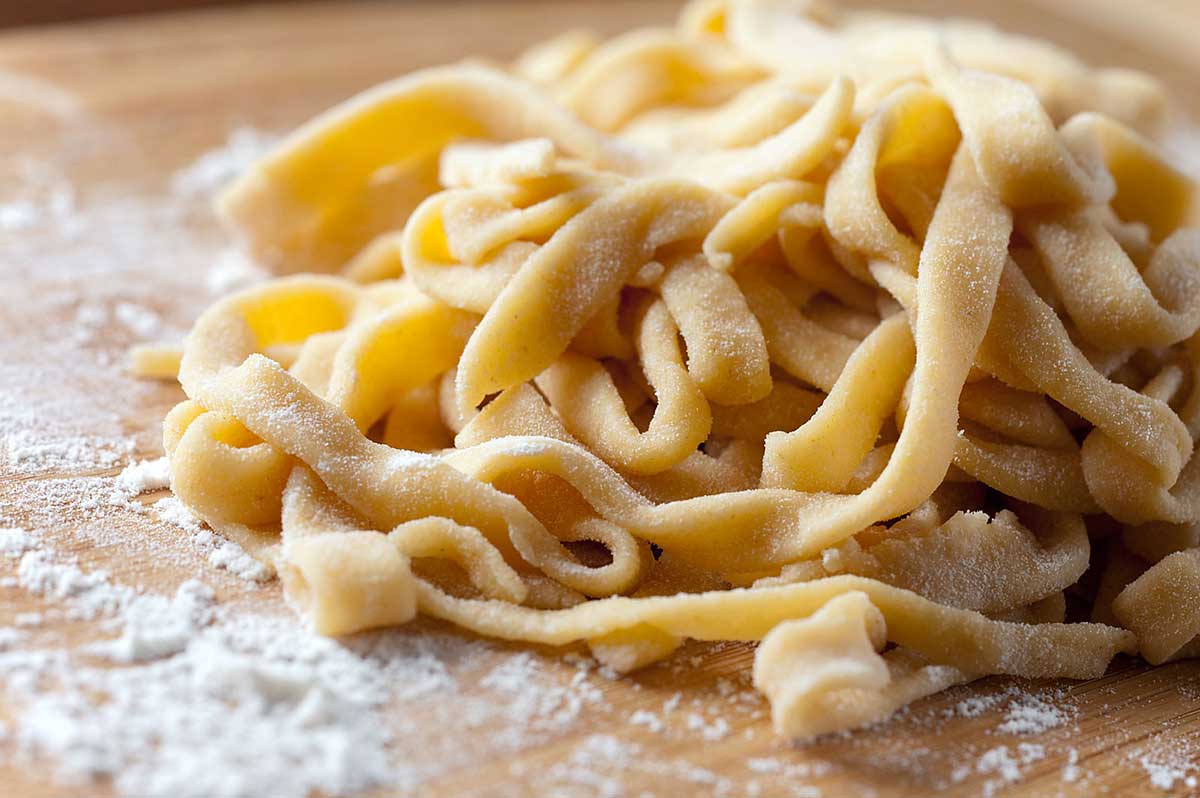
I love the texture of fresh pasta. With a fresh savory sauce, there are few things that could be better. This recipe is summarized from the wisdom of Marcella Hazan from her cookbook Marcellas Italian Kitchen.
- Carbohydrate 57.5713 g
- Cholesterol 186.12 mg
- Fat 5.1086 g
- Fiber 2.02500003576279 g
- Protein 13.2827 g
- Saturated Fat 1.47981 g
- Serving Size 1 1 Serving (119g)
- Sodium 63.1 mg
- Sugar 55.5462999642372 g
- Trans Fat 0.97723 g
- Calories 336 calories
Step-by-step
- Pour the flour onto a clean work surface and shape into a little volcano with a hole in the center.
- Break the eggs into the flour depresion and gently beat with a fork. Draw some of the flour into the eggs and mix gently until the eggs are no longer runny.
- At this point, judge how much flour you think you will need to make a firm, non-sticky dough. Push aside any you think is extra (you can always dip into this later if you need it, but you don't want to have too much in the initial phases). Work the flour and eggs with your hands until combined. Add more flour as needed. Scrape work surface clean and wash your hands in preparation for kneading.
- Knead the dough as you would a standard egg dough for at least 8 minutes. The dough should be relatively easy to work with and should not stick to your hands. Once kneaded, the dough can be wrapped tightly in plastic wrap and kept at room temperature for 2-3 hours before running through the machine.
- To roll out the dough, use the following principle: let it take the stairs, not leap off the building. Set the thinning rollers to their maximum opening. Divide the dough into 4 portions. In preparation for the flattened dough, set a clean dry kitchen cloth next to the machine. To prepare the dough for thinning, flatten slightly and pass through the machine. Fold into thirds, turn 90º, and pass it through again. Repeat 2-3 times, then set the flattened trip on the towel and repeat with the remaining 4 portions.
- To thin the dough: close the opening of the rollers one notch. Pass each dough portion through once, laying it flat on the towel after each pass. Repeat, thinning one notch at a time, until the desired thickness is achieved. If you are making lasagne or cannelloni, you are ready to use the pasta.
- Cutting the pasta: If you are making a noodle like linguine, allow the strips to dry on towels for 10 minutes until they are still soft and pliant, but won't stick together once cut. Gently feed the thinned dough through a cutting roller as desired, and spread the noodles in a cloth towel. Transfer the pasta to boiling water and cook until desired doneness is achieved. Remember, fresh pasta cooks much more quickly than dried, so be ready to drain and not overcook!
Dough Mechanics and Flour Selection
Treating all flour identically yields poor structural results. Choosing all-purpose flour produces a softer bite, whereas durum or semolina creates a robust structure capable of withstanding heavy ragùs. Incorporating eggs gradually into the flour well prevents tearing the outer wall before the moisture is fully absorbed.
Kneading and Rest Intervals
Developing adequate gluten requires at least eight minutes of continuous, firm manipulation. Wrapping the finished ball tightly in plastic wrap allows the gluten strands to relax for two to three hours at room temperature, making the sheet much easier to pass through machine rollers without snapping.
Gradual Rolling and Storage Protocols
Passing the dough through thinning rollers requires incremental adjustments rather than sudden width drops. Closing the machine by a single notch per pass prevents microscopic tearing along the edges. Fresh sheets can be refrigerated for up to twenty-four hours or frozen immediately if dusted lightly with semolina to prevent clumping.



