Kimchi
If I had to name my favorite cuisine, it would be a toss-up between Vietnamese and Korean. Both offer charbroiled meats, pickled or marinated vegetables, and a lively and sometimes spicy array of seasonings.
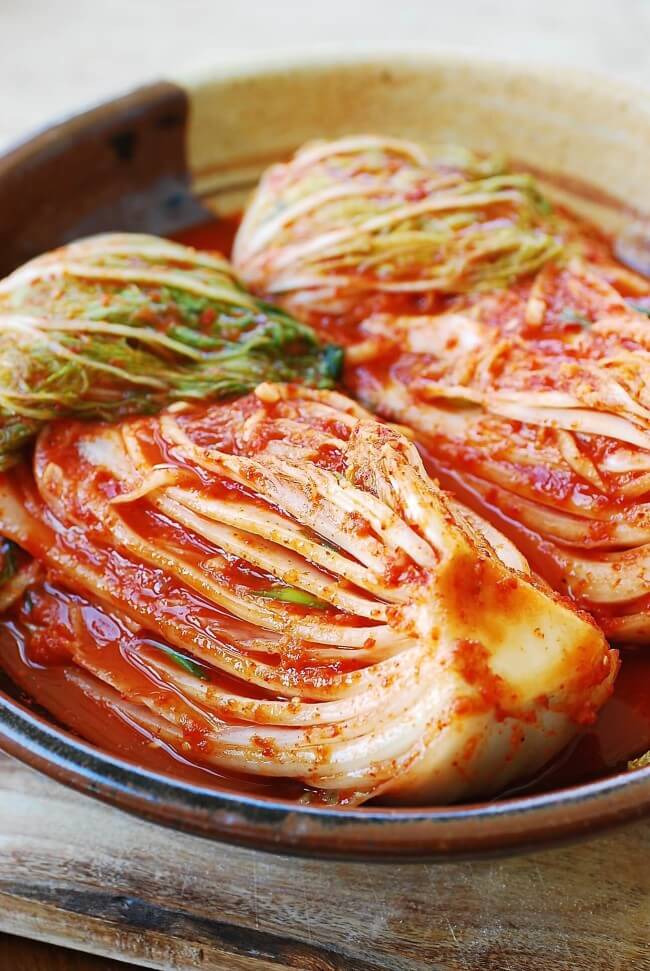
If I had to name my favorite cuisine, it would be a toss-up between Vietnamese and Korean. Both offer charbroiled meats, pickled or marinated vegetables, and a lively and sometimes spicy array of seasonings.
- Carbohydrate 9.37794624846047 g
- Cholesterol 0 mg
- Fat 0.0862404279070414 g
- Fiber 1.44579391635753 g
- Protein 8.9088067536624 g
- Saturated Fat 0.0258212147055079 g
- Serving Size 1 1 Serving (226g)
- Sodium 14820.8523649345 mg
- Sugar 7.93215233210294 g
- Trans Fat 0.0252366996965212 g
- Calories 72 calories
Step-by-step
- Slice the cabbage lengthwise in half, then slice each half lengthwise into 3 sections. Cut away the tough stem chunks.
- Dissolve the salt in the water in a very large container, then submerge the cabbage under the water. Put a plate on top to make sure they stay under water, then let stand for 2 hours.
- Mix the other ingredients in a very large metal or glass bowl.
- Drain the cabbage, rinse it, and squeeze it dry.
- Here’s the scary part: mix it all up. Some recipes advise wearing rubber gloves since the chili paste can stain your hands.
- Pack the kimchi in a clean glass jar large enough to hold it all and cover it tightly. Let stand for one to two days in a cool place, around room temperature.
- Check the kimchi after 1-2 days. If it’s bubbling a bit, it’s ready and should be refrigerated. If not, let it stand another day, when it should be ready.
- Once it’s fermenting, serve or store in the refrigerator. If you want, add a sprinkle of toasted sesame seeds over the kimchi for serving.
Undersalting the cabbage is the single error that ruins most homemade attempts at this classic fermented dish. When coarse salt fails to penetrate the leaves thoroughly during the initial two-hour soak, osmotic pressure remains too low to draw out excess cellular water. The result is limp vegetation that cannot support the pungent paste mixture and spoils prematurely instead of fermenting cleanly. Achieving proper structure requires submerging the Napa cabbage completely in a saline brine weighted down by a heavy plate, ensuring uniform curing before any seasonings are introduced.
Controlling Fermentation Speed and Texture
Rinsing and squeezing the cured leaves removes surface salt while retaining just enough interior seasoning for microbial activity. Blending the garlic, grated ginger, daikon radish, chili paste, fish sauce, and sugar creates a thick slurry that must coat every surface evenly. Wearing rubber gloves during this step protects skin from capsaicin irritation and staining. Pack the seasoned cabbage tightly into a clean glass jar to eliminate air pockets, which promotes anaerobic lactic acid bacteria growth over unwanted molds. Fermentation speed depends entirely on ambient temperature. Keeping the jar in a cool room for 24 to 48 hours usually initiates bubbling, which signals that active fermentation has begun and refrigeration is required.
- Monitor the jar daily for gas bubbles, transferring it to the refrigerator within three days to halt rapid over-acidification.
- Consume the contents within a three-week storage window before the acidity compromises the crisp texture of the radish and cabbage.
- Substitute a large ceramic crock or food-grade plastic container if a standard glass storage jar is unavailable.



