Low Carb Broccoli and Cheese Soup
Great for rainy or cold days. Quick to make and the kids love it. I make this for my daughter who is vegetarian and it is one of her favorites.
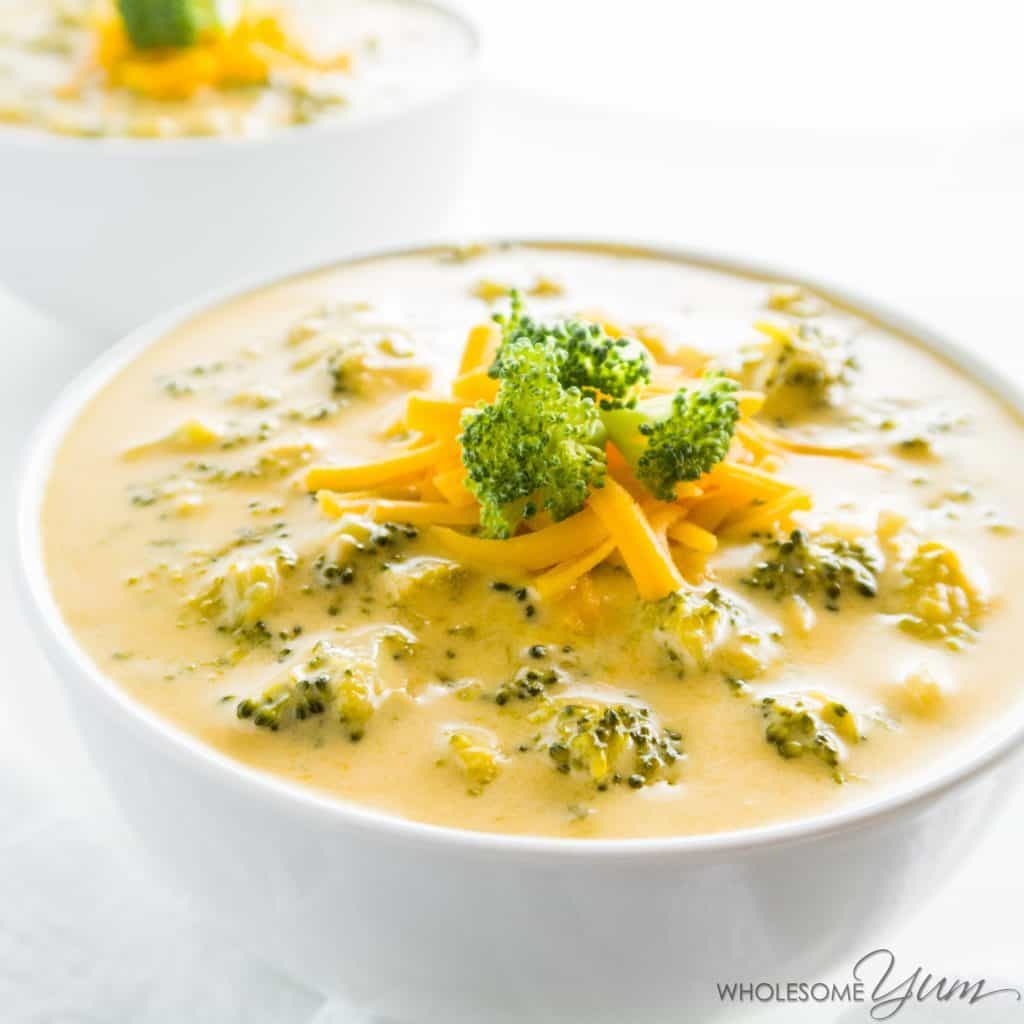
Great for rainy or cold days. Quick to make and the kids love it. I make this for my daughter who is vegetarian and it is one of her favorites.
- Carbohydrate 8.25636055690667 g
- Cholesterol 94.0333333333333 mg
- Fat 28.0691232114946 g
- Fiber 2.24533770141531 g
- Protein 12.57939038712 g
- Saturated Fat 17.2238578373906 g
- Serving Size 1 1 Serving (168g)
- Sodium 275.515121994672 mg
- Sugar 6.01102285549136 g
- Trans Fat 1.6392488303852 g
- Calories 327 calories
Step-by-step
- Heat a large nonstick saucepan over medium-high heat. Add olive oil to the pan. Add onion and garlic, and Oregano and saute 3 minutes or until tender.
- Add flour to broth and whisk it. Add flour broth mixture and broccoli to the pan.
- Bring broccoli mixture to a boil over medium-high heat. Reduce heat to medium, cook 10 minutes or until florets are soft. If you use more than just the florets; ie broccoli stems, you may have to cook longer.
- Stir in pepper. Remove from the heat
- Either use a handheld stick blender and blend randomly right in the pan or place one third of soup in blender or food processor, process until smooth. Return pureed soup to pan.
- Add cream and grated cheese, stirring until cheese melts.
Ingredient lists rarely account for how dairy behaves past twenty-four hours in the refrigerator. Heavy cream and grated cheddar suspensions separate over time, resulting in a thin broth capped by a stubborn fat layer when stored cold. Reheating this soup demands low heat on the stovetop to gently coax the dairy back into the liquid without scorching the milk solids.
Fat emulsions break down permanently if boiled aggressively after the cheese melts. Keep the temperature under 180 degrees Fahrenheit during reheating, stirring continuously with a silicone spatula until the mixture returns to a uniform consistency. Adding two tablespoons of warm broth or water before applying heat can also help restore the original viscosity if the starches have tightened overnight.
Freezing requires caution because high-fat dairy and soft vegetables do not always thaw cleanly. Broccoli florets turn spongy upon thawing due to cell wall collapse, and heavy cream frequently curdles when subjected to sub-zero temperatures. Storing the vegetable and broth base in the freezer without the dairy produces better results, allowing fresh cream and cheese to be whisked in upon thawing.



