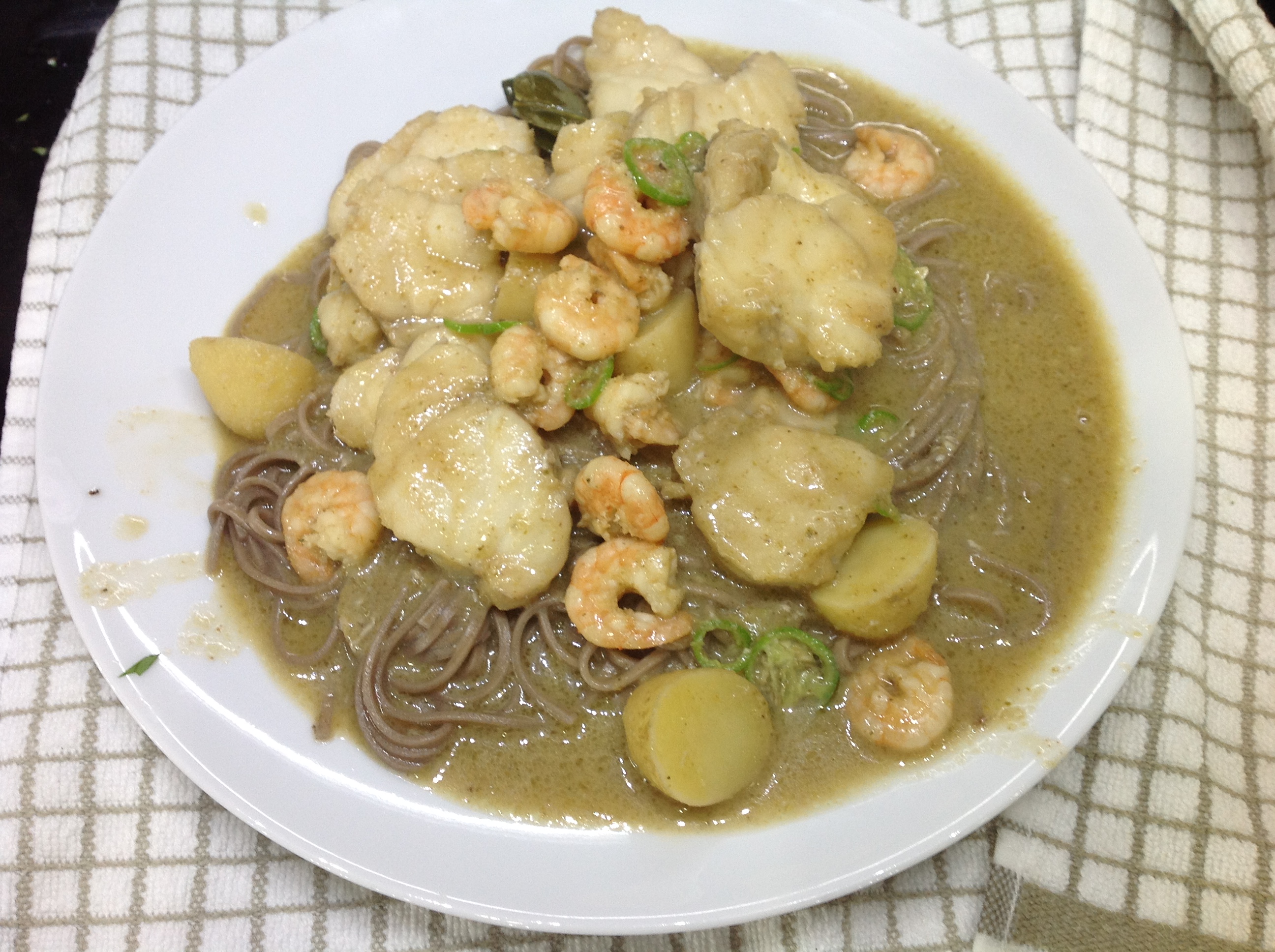
Green Monkfish and Prawn Curry (Stein)
If you put the maximum amount of green chillies in this recipe that I've suggested, you will create a curry of such heat and intensity that you could be sitting in Bangkok. If you like your curries a little milder, use only two chillies. Either way, I hope you'll agree that this is probably the best recipe for green fish curry you have ever tasted. It is fragrant and blindingly hot but also sweet and delicious with the background flavour of coconut.
If you put the maximum amount of green chillies in this recipe that I've suggested, you will create a curry of such heat and intensity that you could be sitting in Bangkok. If you like your curries a little milder, use only two chillies. Either way, I hope you'll agree that this is probably the best recipe for green fish curry you have ever tasted. It is fragrant and blindingly hot but also sweet and delicious with the background flavour of coconut.
- 3 tablespoons oil, sunflower
- 40 gram green curry paste about 40g for emily
- 400 mililiters milk, coconut
- 175 mililiters water
- 2 tablespoons nam pla
- 2 teaspoons sugar, muscovado or palm sugar
- 4 ea kaffir lime leaves or 1 pared sript of lime zest cut into fine shreds
- 1 ea lime juice of
- 100 grams potato, new, very small cut in half if large
- 50 grams baby aubergines or mangetout, quartered
- 12 ea prawns, raw unshelled and headless
- 350 grams monkfish fillets cut across into 1cm slices
- 50 grams bamboo shoots
- 2 tablespoons basil, fresh finely shredded
- 1 ea chili, green finger thinly sliced into rings
- Carbohydrate 2.4353249999832 g
- Cholesterol 0 mg
- Fat 0.0757999999959423 g
- Fiber 0.755999998142112 g
- Protein 0.465874999980029 g
- Saturated Fat 0.0126174999997401 g
- Serving Size 1 1 Serving (84g)
- Sodium 2.17757091235757 mg
- Sugar 1.67932500184109 g
- Trans Fat 0.0295849999992265 g
- Calories 9 calories
Step-by-step
- Heat the oil in a large pan, add the green curry paste and fry for 5-6 minutes, until the ingredients begin to separate from the oil and it starts to smell aromatic. To make the curry paste see p. 215 in the Stein book. If using bought paste, use about 40g for Emily - and it''s still too much. Or double for Mathias.
- Add the coconut milk, water, fish sauce, sugar, lime leaves or zest, lime juice, potatoes and the aubergines, if using.
- Simmer for about 10 minutes, until the potatoes and aubergines are tender. Note that I found the potatoes were still a bit solid after 10 minutes. It''s best to simmer until the potatoes are done and THEN go on to the Prawns and Monkfish.
- Meanwhile, shell the prawns and de-vein them. Cut each one in half lengthways.
- Add the prawns to the pan with the monkfish, bamboo shoots and the mangetout, if using. Simmer for another 2 minutes. Do not simmer for longer that 2 minutes, so you need to make sure ythat the potatoes are done before this stage.
- Stir in the shredded basil and serve sprinkled with the sliced green chilli.
Standard ingredient lists hide how aggressively fish proteins react to residual heat over storage time. Monkfish holds its dense, lobster-like chew better than flaky white fish when reheated, but prawns toughen past redemption if exposed to sustained high temperatures twice. Separating the seafood from the simmering coconut base before packing leftovers preserves texture for the next day.
- Fry the green curry paste in sunflower oil for five to six minutes until the fats split and separate from the solids, which eliminates the raw, bitter taste of unroasted aromatics.
- Simmer the new potatoes until a paring knife slides through with zero resistance before introducing the seafood, because the rapid two-minute window allotted for prawns and monkfish will not soften root vegetables.
- Substitute palm sugar with dark muscovado at a strict one-to-one ratio without altering the final sweetness or caramel background notes of the sauce.
- Store cooked seafood curry in a sealed glass container for no longer than forty-eight hours at 4 degrees Celsius to maintain optimal freshness.
- Reheat portions gently on the stovetop over medium-low heat, stirring constantly, just until steam rises, avoiding microwave hotspots that rubberize the prawns.
Stretching the coconut milk base with an extra splash of water prevents the reduction from becoming overly thick during storage. Day-old curry gains deeper integration as the kaffir lime oils saturate the potatoes.



