Easy & Healthy Shrimp Scampi
My wife discovered this recipe a few years ago, and since I love shrimp, I had to try it. It's a healthy, easy-to-prepare shrimp scampi that skips the usual butter and uses low-sodium chicken broth instead of all white wine. It's incredibly delicious!
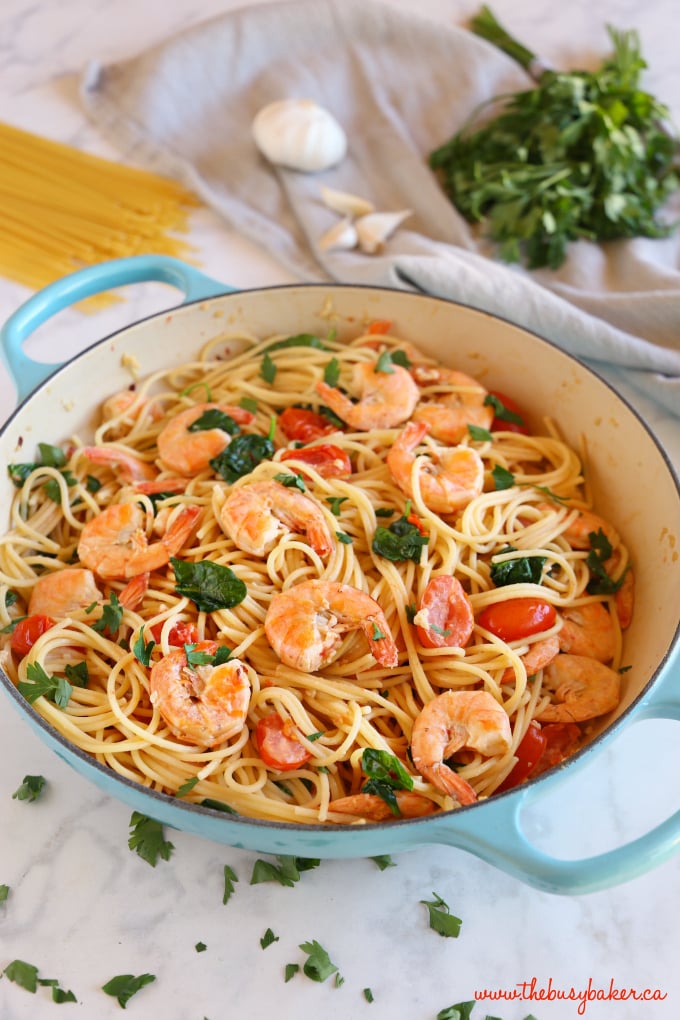
My wife discovered this recipe a few years ago, and since I love shrimp, I had to try it. It's a healthy, easy-to-prepare shrimp scampi that skips the usual butter and uses low-sodium chicken broth instead of all white wine. It's incredibly delicious!
- Carbohydrate 12.1988034772249 g
- Cholesterol 172.5247006 mg
- Fat 3.29050266547667 g
- Fiber 4.16270816972245 g
- Protein 24.8589030868421 g
- Saturated Fat 0.580451409867832 g
- Serving Size 1 1 Serving (241g)
- Sodium 270.87344356712 mg
- Sugar 8.03609530750244 g
- Trans Fat 0.714322510627671 g
- Calories 160 calories
Step-by-step
- In a large nonstick skillet, heat the oil. Saute the shrimp until just pink, about 2-3 minutes. Add the garlic and cook stirring constantly, about 30 seconds. With a slotted spoon transfer the shrimp to a platter and keep them warm.
- In the skillet, combine the broth, wine, lemon juice, 1/4 cup of the parsley, the salt and pepper; and bring it to a boil. Boil uncovered, until the sauce is reduced by half.
- Spoon the sauce over the shrimp. Serve garnished with the lemon wedges and sprinkled with the remaining tablespoon of parsley.
How do you know when shrimp have crossed the threshold from translucent and raw to opaque and overcooked? In a skillet, shrimp transition through clear stages requiring constant visual monitoring rather than a kitchen timer. Raw crustaceans appear greyish-blue and translucent; as heat denatures the proteins, the flesh turns opaque white with pink accents. Pull the shrimp out the exact moment the tails curl inward tightly and the bodies form a loose 'C' shape rather than a closed 'O'. If the shrimp curl into a tight circle, they have stayed in the pan too long and will yield a rubbery texture.
Searing medium shrimp requires a hot surface, preferably a wide nonstick skillet that prevents sticking without requiring excessive fat. Aluminum pans can react negatively with the high volume of fresh lemon juice used here, imparting a metallic tang to the sauce. If a nonstick skillet is unavailable, a well-seasoned cast-iron pan functions adequately provided the oil is shimmering before the shrimp enter. Working in batches prevents overcrowding, which lowers pan temperature and causes the shrimp to steam rather than sear.
Mincing six to eight cloves of garlic demands precision because finely chopped pieces burn in thirty seconds under direct high heat. Add the aromatics only after removing the shrimp, utilizing the residual oil left behind in the skillet. Stir continuously with a wooden spatula, watching for the moment the pungent aroma softens into a sweet, toasted fragrance. Scrape the pan bottom frequently to prevent localized burning before introducing the liquids.
Reducing the sauce requires boiling the chicken broth, dry white wine, and lemon juice uncovered until the volume decreases by half. This evaporation concentrates the natural sugars and acids, thickening the liquid without the need for added starches or heavy fats. Pour the reduced pan sauce over the resting shrimp immediately before serving to allow the warm liquid to coat each piece evenly without continuing the cooking process.



